Domery is an AI analysis assistant for a company's own data, suited to querying business reports, self-service event tracking, document knowledge Q&A, generating reporting material, and unifying definitions across sources.
Domery: a data AI assistant that answers in one question
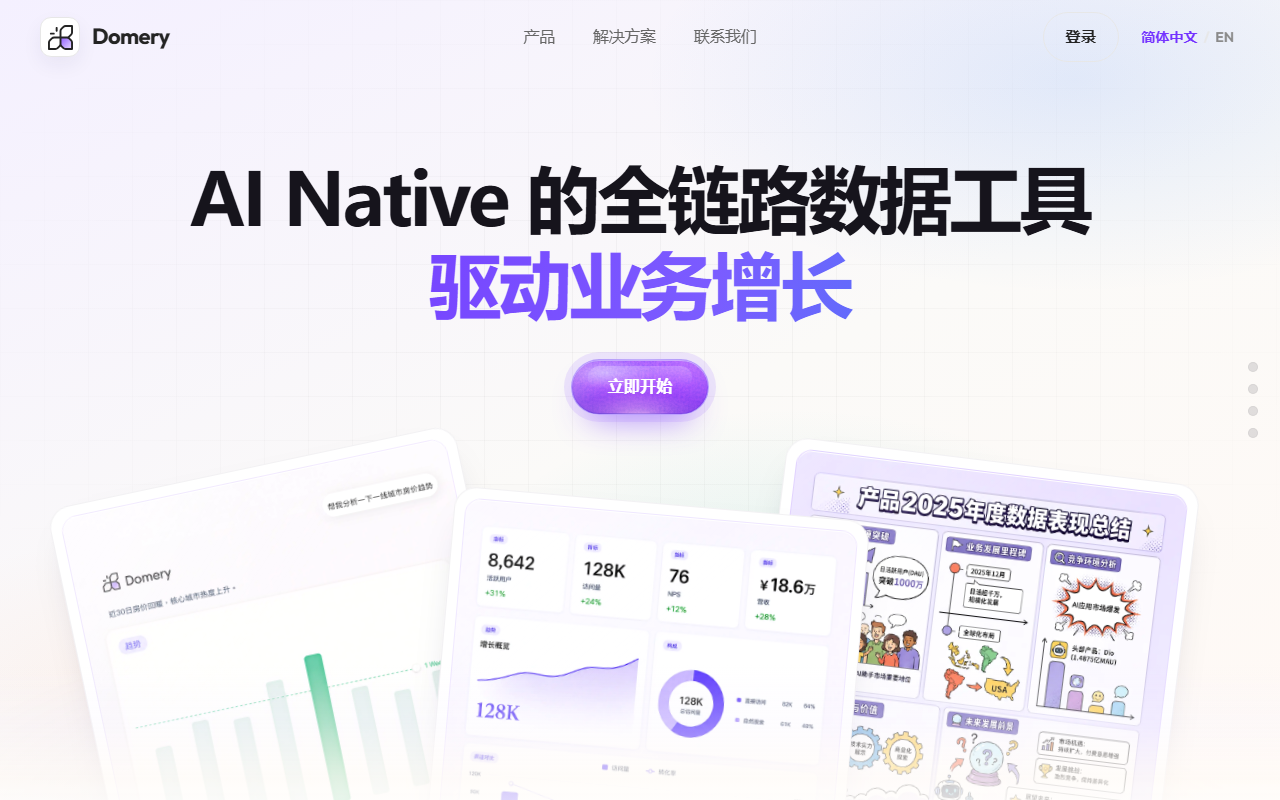
Domery is Tencent's full-chain data AI assistant, aimed squarely at the pile of data a team already owns: event tracking from its own apps, reports exported from several systems, and documents it has uploaded. You do not need to write SQL, and you do not need to paste spreadsheets into a chat box. You ask a question in plain language, and it handles the organizing, analysis, and distillation, then turns the conclusion into a chart, a dashboard, or even a reporting deck.
It addresses a very concrete situation: the data exists, the definitions do not match, and getting a number means joining a queue. When a business owner wants to know how a new feature converted last week, they often wait for the data team, and the answer that comes back may not even line up because the fields were defined differently. Domery's angle is to let the person asking get the answer themselves.
The product covers the whole chain: event collection, multi-source access, analysis, and visual delivery. Collection can generate SDK code for several platforms in one step. Analysis accepts databases, data warehouses, and spreadsheets, with the AI aligning fields and definitions. Delivery offers four visual forms, and the output is presentable enough to drop into a report.
It is reachable through a WeChat mini program and the domery.cn website. It is a Tencent incubated product, currently in internal testing.
What Domery does
One-click event tracking
Covers iOS, Android, H5, mini programs, and server-side, five platform types in total, with SDK tracking code generated and shipped on the spot. The point is that you can start collecting data without waiting for a data team to schedule the work.
Multi-source analysis in one pass
Databases, data warehouses, and spreadsheets all connect, and the AI aligns fields and definitions automatically. Several messy sources can be viewed together in a single question, without building a manual mapping table first.
Knowledge garden
Uploaded documents become a knowledge base that can be reused for repeated Q&A. A conversation can draw on three kinds of context at once: the knowledge base, past conversations, and local files, so background does not need re-explaining every time.
Conversational data analysis
A natural language question is enough to get summarization, distillation, and analysis, without pasting content into a chat box or hand-writing SQL.
Four visual delivery formats
Answers can become AI data illustrations, static HTML pages, dynamic HTML dashboards, or reporting-grade slides. The four cover different occasions, from a quick explanation to a formal review.
Free model switching
Supports DeepSeek, Kimi, GLM, Hunyuan, and others, so the model can be matched to the task instead of forcing one model onto everything.
Reusable capabilities
A tuned analysis flow can be packaged as an agent, a skill, or a scheduled task that keeps running automatically, rather than being re-asked every time.
How to use Domery
- Open the Domery website (domery.cn) and click start, or enter through the WeChat mini program.
- In the knowledge garden, create a knowledge base and upload documents, or connect data sources such as databases, warehouses, and spreadsheets.
- Set access permissions for the data assets and, where necessary, configure SQL templates so the AI matches your business definitions.
- Ask questions in plain language in the conversation, citing the knowledge base, past conversations, or local files as context when needed.
- Review the analysis the AI produces, then choose to output it as a data illustration, an HTML dashboard, or reporting slides.
- Package frequently used analysis flows as agents or scheduled tasks so they keep running in the background.
Where Domery fits
- Automated business reporting: managers query sales, traffic, and core metrics in plain language, and the tool retrieves the numbers and returns charted conclusions without waiting on a queue.
- Self-service event data: app and mini program teams generate multi-platform SDK tracking code, ship it, and check the funnel for a new feature whenever they want.
- Document knowledge Q&A: put product manuals, research reports, and contract PDFs into the knowledge base, and sales or support get answers grounded in the source instead of hunting through files.
- One-click reporting material: weekly, monthly, and retrospective decks no longer need manual assembly; a question produces reporting-grade slides and data illustrations.
- Unified definitions across sources: when databases, warehouses, and spreadsheets disagree, the AI aligns the fields first and then answers consistently, reducing contradictory numbers.
Limitations to know first
- The product is in internal testing, so scope and entry points may change between versions. Confirm current availability before relying on it in production.
- Automatic alignment of fields and definitions lowers manual effort, but it is not the same as completed metric governance. Core metrics should still have their definitions confirmed by the business owner before the AI reuses them.
- The quality of analysis depends on the completeness and accuracy of the underlying data. Missing collection or messy definitions will distort the output.
- Connecting databases and warehouses involves permissions and data security, so access scope should be decided at configuration time rather than relying on a high-privilege account for convenience.
- Generated decks and dashboards work well as drafts or routine reporting. External publication and major decisions still need human review.
Frequently asked questions
Does Domery require writing SQL?
Basic use does not. Asking in natural language is enough to retrieve, summarize, and analyze. For metrics with fixed definitions, SQL templates can be provided at configuration time so the AI computes by your logic.
What data sources can it connect?
Databases, data warehouses, and spreadsheet sources, plus uploaded documents for the knowledge base. Event data is collected through generated SDKs covering iOS, Android, H5, mini programs, and server-side.
What can the analysis be exported as?
Four delivery forms: AI data illustrations, static HTML pages, dynamic HTML dashboards, and reporting-grade slides, matching quick explanation, page sharing, live monitoring, and formal reporting.
Which models are supported?
DeepSeek, Kimi, GLM, Hunyuan, and others can be switched, so the best fit can be chosen per task.
Can analyses run automatically?
Yes. A configured analysis flow can be packaged as an agent, a skill, or a scheduled task and run on a plan without manual questioning each time.
Frequently asked questions
Does Domery require writing SQL?
Basic use does not. Asking in natural language is enough to retrieve, summarize, and analyze. For metrics with fixed definitions, SQL templates can be provided at configuration time so the AI computes by your logic.
What data sources can it connect?
Databases, data warehouses, and spreadsheet sources, plus uploaded documents for the knowledge base. Event data is collected through generated SDKs covering iOS, Android, H5, mini programs, and server-side.
What can the analysis be exported as?
Four delivery forms: AI data illustrations, static HTML pages, dynamic HTML dashboards, and reporting-grade slides, matching quick explanation, page sharing, live monitoring, and formal reporting.
Which models are supported?
DeepSeek, Kimi, GLM, Hunyuan, and others can be switched, so the best fit can be chosen per task.