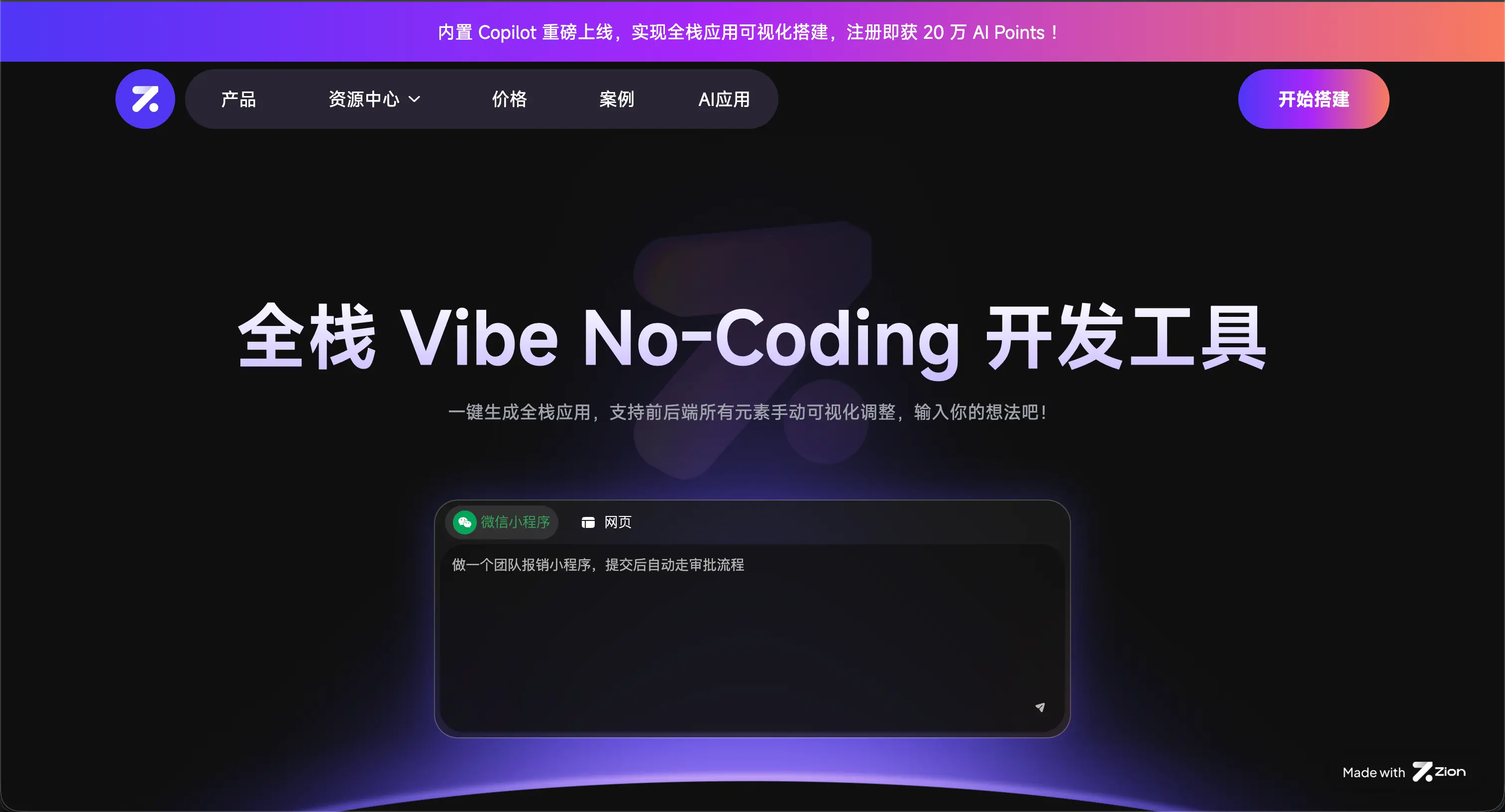
Zion is a full-stack Vibe No-Coding AI application development platform. You describe your requirements in plain language and the AI generates data tables, behavior flows, pages, and permissions as visual no-code resources. The platform includes a relational database, Flexbox visual design, behavior flow logic orchestration, and integrations for APIs, AI, payments, and authentication, and publishes to WeChat Mini Programs and web apps with one click. It suits internal tools, AI applications, SaaS MVPs, and consumer apps.
Zion: Full-Stack Vibe No-Coding AI App Development Platform
Zion is a full-stack Vibe No-Coding AI application development platform. Its central idea is to replace "writing code" with "describing what you need": you explain the app you want in plain language, and the AI generates data tables, behavior flows, pages, permissions, and other visual no-code resources instead of handing you source code to read and debug.

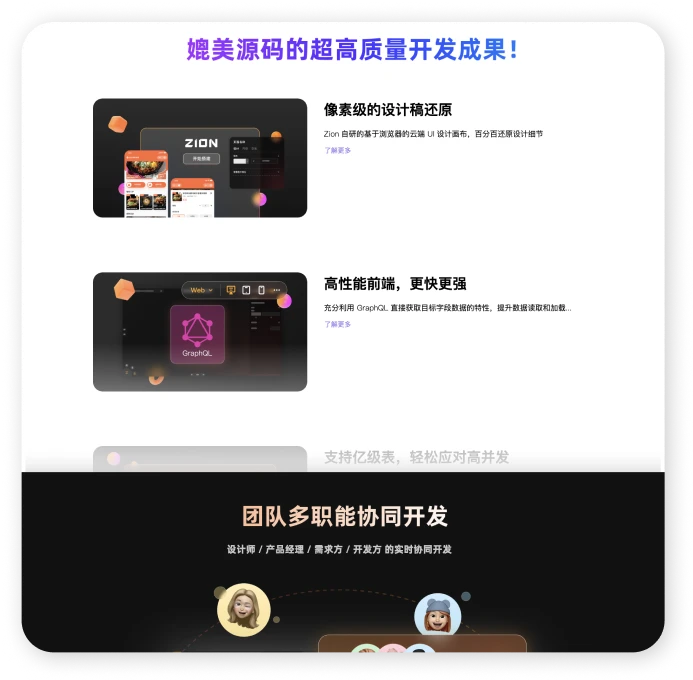
The platform brings interface design, data modeling, backend logic, and multi-platform publishing into one workspace. It includes a relational database and a Flexbox-based visual design system, lets you orchestrate frontend and backend business logic through visual behavior flows, integrates APIs, AI, payments, and authentication, and publishes the result to WeChat Mini Programs or the web with a single click. Alongside the visual path, Zion also offers a Headless BaaS mode that provides a managed backend for external codebases or vibe coding tools, so it serves both no-code newcomers and professional developers with custom requirements.
Key Capabilities
AI App Building: Describe a requirement in one sentence and the AI generates a complete application as visual no-code resources — data tables, pages, and behavior flows you can actually read and change.
Interface Design: Drag and drop components on a Flexbox layout system to build high-fidelity, responsive interfaces that adapt across desktop and mobile.
Data Modeling: A built-in high-performance relational database lets you model complex data visually and manage the data through a friendly interface.
Logic Orchestration: Wire up frontend and backend business logic through visual behavior flows, with integrations for APIs, AI, payments, and authentication.
Multi-Platform Publishing: Publish to WeChat Mini Programs and web apps in one click. iOS and Android packaging is in closed beta, and every platform shares the same backend.
App Operations: Support continuous iteration, fine-grained permission control, and resource usage monitoring.
AI App Infrastructure: Built-in data preprocessing and large model connectivity make precise AI responses inexpensive to implement.
Headless BaaS: When you build the frontend in an external codebase or vibe coding tool, Zion supplies the managed backend.
Extensibility: Code components and run-code nodes cover advanced customization requirements.
How to Use Zion
- Sign up: Visit the Zion website at https://www.functorz.com/ , create an account, and enter the Zion workspace.
- Describe your requirement: Tell the AI in natural language what app you want. It generates the data tables, pages, and behavior flows for you.
- Review the AI output: Look at the generated interface, data model, and logic visually in the editor to confirm they match your expectations.
- Adjust manually: Drag components, refine the data model, and edit behavior flows to fine-tune the application.
- Preview in real time: Use the preview feature to verify the result on desktop and mobile.
- Configure publishing: Set the page path, SEO options, and other publishing settings.
- Publish: Ship it as a WeChat Mini Program or a web application.
- Operate and iterate: Maintain and improve the live app with permission control and usage monitoring.
Use Cases
- Internal business tools: Build CRM, approval, and project management systems without waiting on a development queue.
- AI apps and agents: Use the built-in model connectivity and data preprocessing to build customer support Q&A and knowledge base apps cost-effectively.
- SaaS MVPs: Founders generate a working prototype with the AI, put it live to validate demand, then iterate and extend it.
- Consumer applications: Flexible interactions satisfy end-user expectations for community, content, and e-commerce Mini Programs and web apps.
- WeChat Mini Program development: Publish a Mini Program in one click with a shared backend across platforms — a fast fit for small and mid-sized merchants.
Limitations and Caveats
- iOS and Android native packaging is in closed beta, so mobile availability depends on actual platform progress.
- The AI produces a general-purpose skeleton. Complex business rules, edge cases, and exception flows still need manual review and completion in the editor.
- The Flexbox layout system brings consistency, but highly customized pixel-level designs may still require fine-tuning through code components.
- No-code does not mean zero cost: data modeling, permission design, and business process definition still demand thought and verification.
FAQ
How is Zion different from typical AI code generation tools? Zion's AI output consists of visual no-code resources — data tables, pages, and behavior flows — rather than a code repository, so non-technical people can read and modify it directly. The platform also ships with the database, backend logic, and publishing, so you don't have to stitch together separate backend and deployment solutions the way you would with a pure code generation tool.
Is Zion suitable for people without a programming background? Yes. Describe your requirement in natural language and the AI generates the app; from there you adjust it by dragging components and orchestrating visually. That said, building complex business systems still requires understanding the data structures and the business logic themselves.
Which platforms can Zion publish to? Currently WeChat Mini Programs and web applications, with iOS and Android packaging in closed beta. All platforms share the same backend, which avoids duplicated cross-platform development.
Can Zion work with my own codebase? Yes. Headless BaaS mode provides a managed backend for external codebases and vibe coding tools, and the platform supports code components and run-code nodes for advanced custom needs.
Frequently asked questions
How is Zion different from typical AI code generation tools?
Zion's AI output consists of visual no-code resources — data tables, pages, and behavior flows — rather than a code repository, so non-technical people can read and modify it directly. The platform also ships with the database, backend logic, and publishing, so you don't have to stitch together separate backend and deployment solutions the way you would with a pure code generation tool.
Is Zion suitable for people without a programming background?
Yes. Describe your requirement in natural language and the AI generates the app; from there you adjust it by dragging components and orchestrating visually. That said, building complex business systems still requires understanding the data structures and the business logic themselves.
Which platforms can Zion publish to?
Currently WeChat Mini Programs and web applications, with iOS and Android packaging in closed beta. All platforms share the same backend, which avoids duplicated cross-platform development.
Can Zion work with my own codebase?
Yes. Headless BaaS mode provides a managed backend for external codebases and vibe coding tools, and the platform supports code components and run-code nodes for advanced custom needs.