Zhuque AI Detector is an AI content detection assistant that judges whether text, images or video were generated by AI. It covers mainstream models including GPT-4, Claude, DeepSeek, Gemini and Doubao, supports Chinese and English text checks, and returns an analysis report with flagged passages. Results are advisory, so they suit academic integrity checks, platform moderation and copyright protection.
Zhuque AI Detector: One-Stop Detection for AI-Generated Text, Images and Video
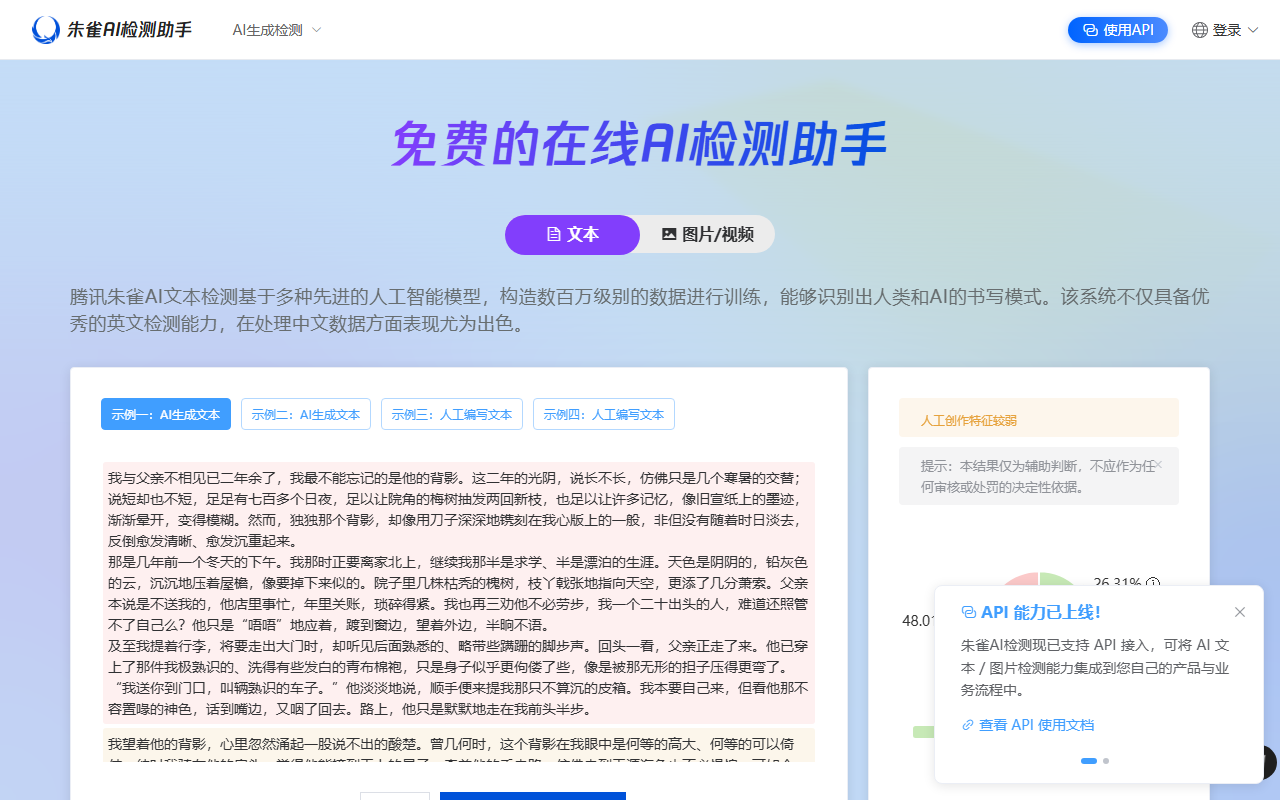
What it is
Zhuque AI Detector is an all-round AI content detection assistant that identifies text, images and video produced by artificial intelligence. Built on trained models and large-scale data, it returns a probabilistic judgement on what you submit and marks the passages that look suspicious, so a human reviewer can take the next step.
For text it covers output from mainstream large models such as GPT-4, Claude, DeepSeek, Gemini and Doubao, in both Chinese and English. For images it covers common text-to-image generators and GAN output, including Jimeng, Flux, Midjourney and Stable Diffusion. For video it recognises material produced by text-to-video models such as Hunyuan, Sora, Hailuo and Veo.
One point matters: the result is an advisory signal, not a verdict. It works well wherever content needs a first pass - academic integrity, social media moderation, data quality control - but it should never be the sole basis for a decision.
Key capabilities
Text detection. It identifies AI-written articles, papers and other text and flags the suspicious passages, so reviewers can jump straight to the parts that need a closer look. Both Chinese and English are supported.
Image detection. It checks pictures produced by image generators such as Hunyuan, Doubao, Jimeng and Stable Diffusion across common image formats, helping you judge whether an image was synthesised.
Video detection. It recognises video created by models such as Hunyuan, Jimeng and Sora, and works with MP4, MOV and AVI files.

Fits many workflows. The same detection stack serves social media moderation, academic integrity work and data quality control, so you do not need a separate tool per content type.
How to use it
- Open the official site at https://matrix.tencent.com/ai-detect/ and go to the detection page.
- Pick the entry point that matches what you are checking: text, image or video.
- Click upload and choose the file. Supported formats include TXT, DOCX, PNG, JPG, WEBP, MP4, MOV and AVI.
- Once the upload finishes, start the check and wait for the analysis to complete.
- Read the analysis report for the overall verdict and the specific parts flagged as possibly AI-generated.
- Download the report for your records, and manually review anything that carries consequences.
Who it suits
- Academic research and education: check whether papers or student assignments were AI-generated, helping institutions protect academic integrity and assess real writing ability.
- Content creation and publishing: verify the originality of articles and book manuscripts before publication.
- Social platforms: help moderation teams spot AI-generated material and reduce the spread of false or misleading content.
- Copyright and compliance: help rights holders identify unauthorised AI-generated material and protect intellectual property.
- News media: verify that reporting is authentic and original before it goes out.
Limitations
- Results are probabilistic and can be wrong in both directions, so they should not be the only basis for penalties, rejections or formal findings.
- Heavily rewritten, repeatedly polished or mixed human-AI content is significantly harder to detect.
- Uploading means the content is processed by an online service, so think twice before submitting unpublished work, private material or trade secrets.
- Public material does not state pricing or usage quotas; the actual scope follows what the product page says.
Frequently asked questions
Can I treat the result as a final conclusion? No. It is a probabilistic judgement from a trained model and can be wrong; the product itself recommends manual review before acting on it.
Which content types are supported? Text, images and video, across TXT, DOCX, PNG, JPG, WEBP, MP4, MOV and AVI.
Does it handle Chinese? Yes. Text detection supports both Chinese and English.
Which generators can it recognise? Text: GPT-4, Claude, DeepSeek, Gemini, Doubao and other mainstream models. Images: Jimeng, Flux, Midjourney, Stable Diffusion and more. Video: Hunyuan, Sora, Hailuo, Veo and other text-to-video models.
Frequently asked questions
Can I treat the result as a final conclusion?
No. It is a probabilistic judgement from a trained model and can be wrong; the product itself recommends manual review before acting on it.
Which content types are supported?
Text, images and video, across TXT, DOCX, PNG, JPG, WEBP, MP4, MOV and AVI.
Does it handle Chinese?
Yes. Text detection supports both Chinese and English.
Which generators can it recognise?
Text: GPT-4, Claude, DeepSeek, Gemini, Doubao and other mainstream models. Images: Jimeng, Flux, Midjourney, Stable Diffusion and more. Video: Hunyuan, Sora, Hailuo, Veo and other text-to-video models.