
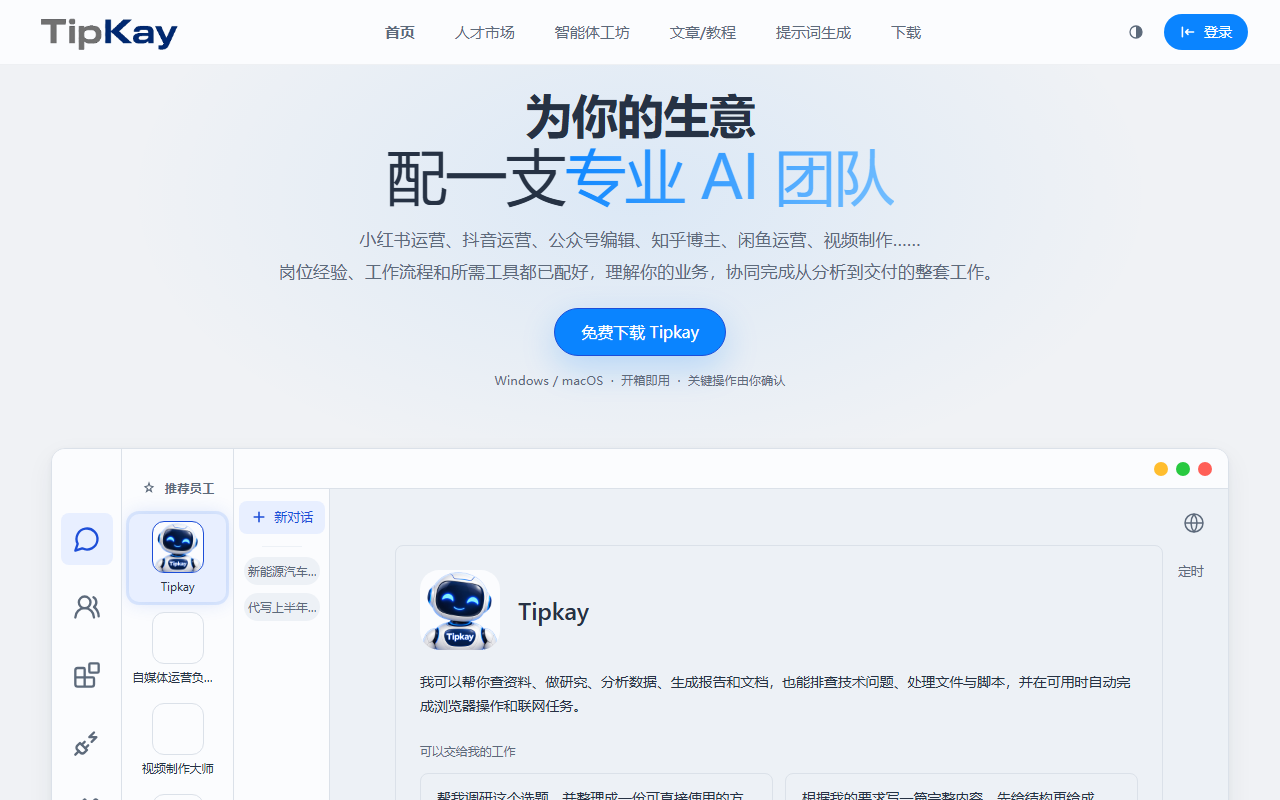
TipKay is a desktop AI client where several vertical agents split different content tasks. It covers the chain from topic planning and material handling through copy and video production to pre-filling publishing pages on multiple platforms. The final publish button is always clicked by the user, and platform login sessions stay on the local machine.
TipKay: a desktop multi-agent client that links topics to publishing
TipKay is a desktop multi-agent AI client with builds for Windows and macOS. Its proposition is not another chat window but a single application that absorbs the most repetitive stretch of content operations: topic selection, drafting, layout and cover images, video finishing, and pre-filling publishing pages across platforms. You describe the goal in everyday language, the client routes it to a vertical agent, and the final publish step stays with a human.
The real problem here is the seam between steps. Topics get noted in one place, copy written in another, covers made in a third tool, and publishing means pasting into each platform by hand. Every switch costs formatting and repetition. TipKay gathers those stages into one client and uses cross-posting to adapt one piece of content into several platform forms, cutting transport work rather than creative judgement.
The second design choice is containment of permissions. Login sessions for each platform live only on the local machine and are not visible to the server. Content can be filled into publishing pages automatically, but the submit action must be a human click. For a team running several accounts, that is easier for platforms to accept than fully automatic posting, and it keeps mis-sends and wrong-account publishing inside a controllable boundary.
Main capabilities
Plain-language operation
There are no menus to learn or prompt templates to memorise. You describe the need in ordinary words, such as a note about a specific product or a short video on a given theme. The client breaks it into a topic angle, copy structure, image style and tag strategy, then calls the right tool.
End-to-end content workflow
Topic planning, copy generation, material handling, layout and finishing run inside one client. Input can be a text request or an attached image or link, which removes most export-import cycles between separate programs.
Two production tracks
The text track covers six platform families including Xiaohongshu, WeChat Official Accounts, Toutiao, Zhihu, Juejin and CSDN. The video track covers Douyin, Kuaishou, WeChat Channels, Xiaohongshu, Bilibili and Toutiao, with a built-in video agent handling editing, subtitles and export. Both tracks share the same account and material store, which suits creators publishing in both formats.
Vertical agents instead of one generalist
The app marketplace includes dedicated agents for Xiaohongshu notes, Zhihu answers, blog publishing, video production and slide decks, each scoped to one task. Narrow scope means shorter prompts and steadier output than a single generalist assistant, and it is easier to see which stage failed.
Scheduled tasks with logs
Repetitive operations can be scheduled, for example generating a batch of draft notes every morning. The job runs on time and leaves an execution log. Output stops at the review state rather than going live, which is the right fit for a fixed publishing rhythm.
Multiple models and extensions
GPT, Claude, Doubao and DeepSeek are built in and switchable in one interface, so there is no need to register with each provider separately. The client also supports graphical installation of MCP servers and loading Skills, so capabilities can be extended on demand.
A clear line between cloud and local
Conversations, brand packs and account assets sync to the cloud and follow you across devices. Platform login sessions and private extensions stay on the local machine. That boundary is the security model: content assets are portable, account credentials are not.
How to use it
- Download the client for your system (Windows 10/11 or macOS 12 and later) and install it. It connects directly without extra network configuration.
- Register an account. New users receive a welcome credit split across registration, activation and completing starter tasks, with a small daily check-in top-up.
- Open the app marketplace and pick an agent by task: the Xiaohongshu agent for notes, the video agent for clips, the blog agent for technical articles.
- Describe the request in plain language and attach images or links if useful. The client decomposes the task and calls its tools, with a single generation typically taking about a minute.
- Preview the result. Continue the conversation to adjust, for example asking for a livelier title or a different cover image.
- Confirm and let the client pre-fill the publishing page on the target platform, reusing the local login session.
- Review the filled content and click publish yourself. The last step stays in human hands.
Cost
- Registration grants a welcome credit totalling 38 CNY, released in stages across registration, activation and starter tasks, plus a 0.2 CNY daily check-in top-up.
- The source does not publish subscription prices, credit consumption rates or per-model billing differences. Before long-term use, confirm the current credit rules and top-up options inside the client.
- Switching models does not change the client's credit logic, but consumption speed can differ between models, so a small test task is worth running before batch generation.
Where it fits
- Xiaohongshu operations: product notes, recommendation posts and store visits produced with topic, copy and cover in one place, suited to individual creators and small operations teams.
- Local businesses: florists, restaurants, gyms and salons without dedicated marketing staff can keep a steady output of promotional posts and short videos.
- E-commerce promotion: drop in product details or a link to generate selling notes and short videos, then test which framing performs with volume.
- Multi-platform distribution: one piece adapted to six text platforms and several video platforms, widening reach while skipping repeated formatting.
- Short video production: talking-head clips, product showcases and daily records with editing and subtitles across Douyin, Kuaishou, WeChat Channels and Bilibili.
- Technical writing: use the blog agent for technical articles and syndicate to CSDN, Juejin, Zhihu and Toutiao.
Limits
- Publishing must be clicked by a person. This is deliberate design, not a gap: fully unattended posting is not a path the tool offers.
- Login sessions live only on the local machine, so a new device or a reinstall means logging into each platform again. Cloud sync does not cover this.
- Generated copy still needs factual checking. Product specs, prices and efficacy claims are the publisher's responsibility under each platform's rules on exaggerated advertising.
- Cross-platform adaptation mainly solves format and field pre-filling. Community guidelines, reach limits and sensitive-word policies differ per platform, so one draft is not automatically right everywhere.
- The source publishes neither subscription pricing nor credit consumption details, nor the scope of commercial licensing. Confirm billing inside the client before a team purchase.
- Output quality varies noticeably between agents. Vertical tasks go better with the matching agent, while forcing a general agent onto a specialist job tends to produce generic text.
FAQ
How is this different from a chat-style AI?
A chat assistant delivers advice; you still lay it out and paste it into each platform. TipKay delivers a filled publishing page, with content, cover and tags placed in the target platform's form, leaving the publish click to you. The saving is transport, not model capability.
Does pre-filling risk being treated as automated activity?
The design keeps the submit action with a human, keeps sessions local, and fills content through the local logged-in environment. That lowers the chance of being classified as a scripted batch, but it cannot guarantee a platform never triggers risk controls. Posting frequency and content quality remain the main variables.
How many platform accounts can one machine manage?
The text and video tracks together cover more than ten publishing targets. How many accounts can stay logged in at once depends on each platform's own rules on multiple accounts, so check those rules before running several accounts on the same platform.
Can scheduled tasks replace manual work entirely?
No. A scheduled task runs the creation flow at a set time and leaves a log, with output waiting for review. Treat it as preparing drafts in advance rather than as unattended publishing.
How long does the welcome credit last?
The source only states a total of 38 CNY released in stages and gives no consumption figure per task, so it cannot be converted into a number of posts. Run one or two small tasks to observe consumption before topping up.
Frequently asked questions
How is this different from a chat-style AI?
A chat assistant delivers advice; you still lay it out and paste it into each platform. TipKay delivers a filled publishing page, with content, cover and tags placed in the target platform's form, leaving the publish click to you. The saving is transport, not model capability.
Does pre-filling risk being treated as automated activity?
The design keeps the submit action with a human, keeps sessions local, and fills content through the local logged-in environment. That lowers the chance of being classified as a scripted batch, but it cannot guarantee a platform never triggers risk controls. Posting frequency and content quality remain the main variables.
How many platform accounts can one machine manage?
The text and video tracks together cover more than ten publishing targets. How many accounts can stay logged in at once depends on each platform's own rules on multiple accounts, so check those rules before running several accounts on the same platform.
Can scheduled tasks replace manual work entirely?
No. A scheduled task runs the creation flow at a set time and leaves a log, with output waiting for review. Treat it as preparing drafts in advance rather than as unattended publishing.