
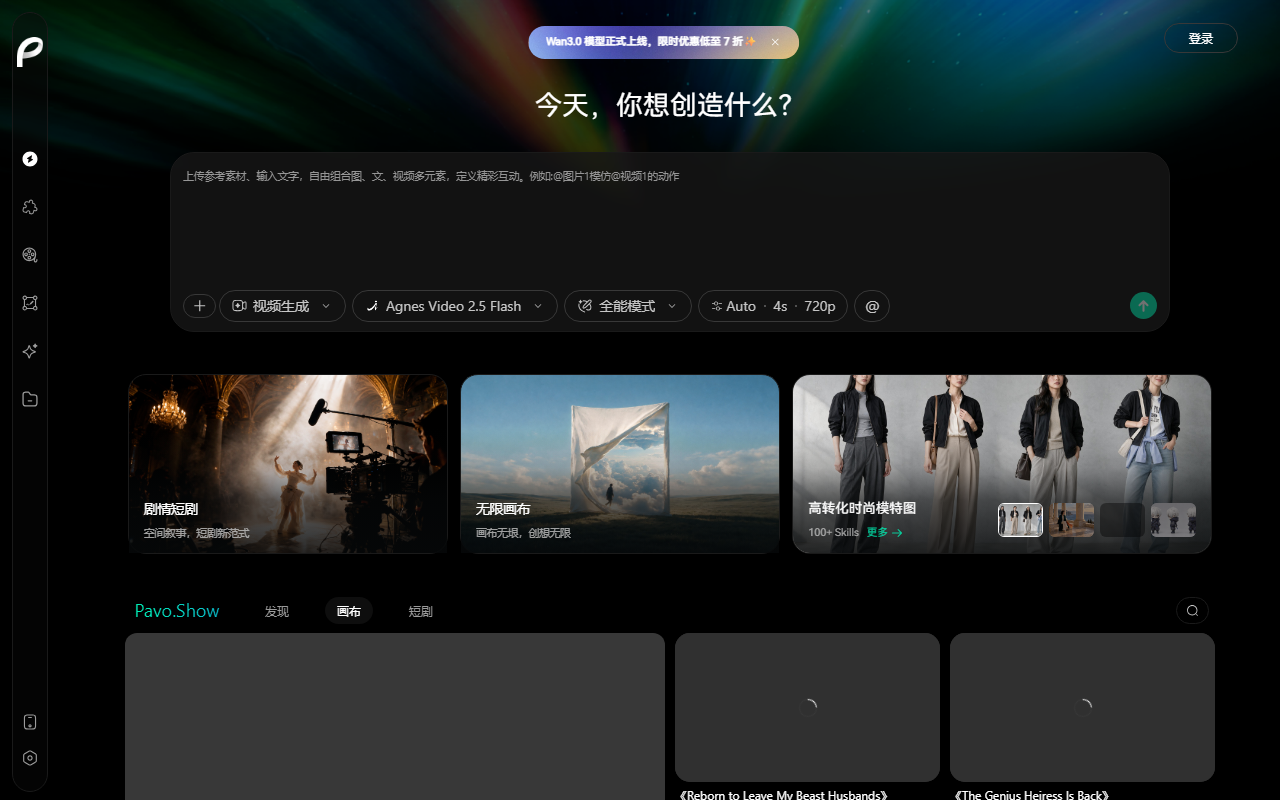
Pavo is an AI short-drama video creation platform launched by Agnes AI: users enter a one-sentence idea or script, the AI automatically breaks it down into a complete plan, working through character design, scene construction, storyboard, keyframes, and the finished video, with a built-in Agent guiding the entire process.
What Is Pavo? An AI Short-Drama Platform That Starts With One Sentence
Pavo is an AI short-drama video creation platform launched by Agnes AI. Users enter a one-sentence idea and the AI automatically breaks it down into a complete plan, working through character design, scene construction, storyboard, keyframes, and the finished video. It also supports natural-language iterative edits and locks character consistency across multiple shots to keep the visuals coherent.
Product Positioning
Based on public descriptions, Pavo is not aimed at single-asset generation but at a complete short-drama production pipeline: ideas go in, finished videos come out. The platform has a built-in Agent that guides the entire process, with a clear goal — lowering the barrier to professional creation so that short dramas, ads, and narrative short films no longer depend on a full production crew.
It serves short-drama teams, brands, self-media creators, educational and training content producers, and entertainment-oriented authors doing fan IP derivative work.
Core Features
Agent
The built-in AI creation assistant guides users through interactive creation steps such as confirming requirements, modifying characters, and adjusting storyboards.
Narrative Short-Film Plan Generation
Users enter a one-sentence idea or script, and the AI automatically breaks it down into a complete production plan, including title, synopsis, duration, aspect ratio, storyboard-splitting mode, and visual style.
Image Generation
Based on the Agnes Image 2.1 Flash model, it generates high-quality concept art and keyframe images for characters, scenes, and props.
Storyboard
Automatically breaks the script into multi-shot storyboards, including visual composition, camera movement, sound effects, character dialogue, and duration allocation.
Character Consistency Locking
During storyboard drawing, the platform locks a character's good looks, wardrobe, and props to keep the character's appearance unified across multiple shots.
Video Generation
Calls the Agnes Video v2.0 / Seedance models to convert storyboard keyframes into coherent motion video and output the final finished video.
How to Use Pavo: Run a Short-Drama Workflow in Six Steps
- Visit the official website: Go to the Pavo official website at https://app.pavo-ai.work/, register, and log in.
- Enter your idea: In the creation area, type a one-sentence idea or a full script, or upload a reference image.
- Confirm the requirement card: The AI automatically generates a production plan including title, synopsis, duration, aspect ratio, style, and more. Confirm it or modify it, then move to the next step.
- Design visual elements: Confirm character design, scene design, and core prop design in sequence. Natural-language instructions can be used for iterative edits.
- Confirm the storyboard: Review the multi-shot storyboard split by the AI; once satisfied, proceed to keyframe generation.
- Generate keyframes and video: The AI draws keyframes for each shot; after confirmation, it calls the video model to generate a complete, coherent short-drama video.
Throughout the process, every step can be revisited or redone with conversational instructions — this is what sets Pavo apart from a “generate once, start over if unsatisfied” approach.
Pavo Use Cases
- AI short-drama production: Enter a one-sentence idea and automatically generate a complete short drama with storyboards, characters, and dialogue — suitable for rapidly producing serialized content such as power-fantasy (爽剧) and xianxia cultivation dramas.
- Brand ad short films: Turn product selling points into narrative ads, reducing the cost of traditional TVC shooting and post-production.
- Self-media content creation: Bloggers and video creators without professional experience can quickly produce narrative video assets with character consistency, suitable for platforms such as Douyin and Kuaishou.
- Teaching and demo animations: Break knowledge points or corporate training content into visual storyboards and generate narrative teaching short films as an alternative to traditional PPT.
- Fan IP and entertainment creation: Create derivative works based on novels or game characters. The AI locks character looks for multi-shot consistency — a fit for comedic contrast skits, fan short dramas, and other entertainment content.
Pavo's Core Strengths
- End-to-end short-drama workflow: Covers the full industrialized pipeline from idea → requirement card → characters/scenes/props → storyboard → keyframes → finished video, with no manual splicing.
- Natural-language iteration control: Users can modify character looks, scene atmosphere, and more with conversational instructions at any time, and the AI regenerates the corresponding assets in real time.
- Cinematic storyboard breakdown: Every shot comes with camera movement, sound design, and character dialogue, close to professional film-storyboard standards.
- Character and prop consistency: Locks character faces, wardrobe, and core props across multiple shots, avoiding the character-corruption problems common in AI video.
- Guided, low-barrier workflow: The built-in Agent runs through the whole pipeline, so non-professional users can follow the prompts to complete production.
Limitations and Notes
- Output stability: A user comment on the public page reads, “It's quite good, but the output isn't very stable; you need to run it multiple times.” This means the same idea may need several rounds of generation before you get a satisfactory result, so budget time for trial and error.
- Consistency has design boundaries: Character consistency locking applies to the storyboard-drawing stage and is a design goal of the platform, not a guarantee that every asset combination will be flawless. Key checkpoints still need human review.
- Many manual confirmation points: The requirement card, characters, scenes, props, storyboard, and keyframes each require confirmation. The workflow is complete, but the review cost is not negligible.
- Models and features may change: The models and capabilities mentioned in this article are subject to whatever the official website currently shows.
Price Verification Note
Public first-party materials emphasize that Pavo is “the first video, short-drama, and image creation platform that is truly free with unlimited time,” and state that Agnes AI has opened its full-modal API for free. Pricing, free allowances, export conditions, and availability are details that can change at any time. Before you start creating, visit the official website at https://app.pavo-ai.work/ to verify the current policy; do not use this article as a basis for payment decisions.
Pavo FAQ
Is Pavo free?
First-party materials describe it as a video, short-drama, and image creation platform that is truly free with unlimited time, and mention that Agnes AI offers its full-modal API for free. Please refer to the latest information on the official website.
How many steps does it take to make a short drama with Pavo?
Six steps: visit the official website and register/log in, enter your idea, confirm the requirement card, design visual elements, confirm the storyboard, and generate keyframes and video.
How does Pavo keep characters consistent across shots?
The platform locks a character's face, wardrobe, and core props during storyboard drawing, keeping the character's appearance unified across multiple shots.
Can complete beginners get started?
The platform has a built-in Agent that guides the entire process; requirement confirmation, character edits, and storyboard adjustments all come with interactive prompts, so the barrier is relatively low.
How to Think About Alternatives
The table of contents of the public page lists “Pavo vs. similar competitors” and “Tools similar to Pavo,” but no specific competitor names or data are given, so we won't name specific recommendations here. When evaluating alternatives, you can compare these dimensions: whether it covers an end-to-end short-drama workflow, whether it supports multi-shot character consistency locking, whether it allows natural-language iterative editing, whether it has a guided Agent, and the differences in free allowances and export conditions. For specific competitor information, refer to each product's official website and first-party materials.
Official website: https://app.pavo-ai.work/
Frequently asked questions
What is Pavo?
Pavo is an AI short-drama video creation platform launched by Agnes AI. Users enter a one-sentence idea, and the AI automatically breaks it down into a complete plan, working through character design, scene construction, storyboard, keyframes, and the finished video.
Is Pavo free?
Public first-party materials emphasize that Pavo is “the first video, short-drama, and image creation platform that is truly free with unlimited time,” and state that Agnes AI has opened its full-modal API for free. Pricing and free allowances are subject to change; verify the current policy on the official website at https://app.pavo-ai.work/
What steps are needed to create a short drama with Pavo?
There are six steps: visit the official website and register/log in; enter a one-sentence idea, a full script, or upload a reference image; confirm the AI-generated requirement card; confirm the character, scene, and core prop designs in sequence; confirm the storyboard; then generate keyframes and call the video model to output the finished video.
How does Pavo keep characters consistent across shots?
The platform locks a character's good looks, wardrobe, and props during storyboard drawing, keeping the character's appearance unified across multiple shots and avoiding the character-corruption problems common in AI video.
What scenarios is Pavo suitable for?
AI short-drama production, brand ad short films, self-media content creation, teaching and demo animations, and fan IP and entertainment creation — narrative video content in general.
What known limitations does Pavo have?
A user comment on the public page notes that “the output isn't very stable; you need to run it multiple times,” meaning results may require several rounds of generation. There are also many manual confirmation points from the requirement card to keyframes, and the models and features are subject to the official website's current information.