Nooka is an AI audiobook summary app that compresses bestselling nonfiction into 20-minute audio summaries. Listeners can pause the host to ask questions and get answers about the current book, clip passages into shareable audio cards, and read subtitles in English, Japanese or Spanish. Pricing, library size and platform support are not publicly disclosed.
Nooka: 20-minute audiobook summaries you can interrupt with a question
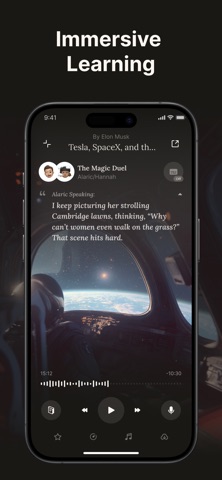
Nooka is an AI audiobook summary app from PawLogic Limited, and its product shape is deliberately narrow: it explains a bestselling nonfiction book in 20 minutes of audio, turning commutes, walks and chores into input time. The difference from an ordinary audiobook is that it can be interrupted. You can pause the host, ask a question, and get an answer tied to what you just heard. Afterwards you can cut a segment into a shareable audio card.
The real cost of nonfiction audio is not money but hours. A business book runs eight to twelve hours, and many listeners stop around chapter three. Nooka compresses one book into 20 minutes, roughly a single commute: the central argument, the cases that support it, and what the conclusion means for the reader. That length cannot replace the book, but it is enough to judge whether the book deserves a closer read.
The second design decision turns playback into a conversation. The official description says listeners can pause the host to ask a question, which implies a host-narrated audio format and questions answered inside the context of the current book rather than sent to a search engine. This targets a specific kind of stall: you understood the words but lost the thread, whether a term, the origin of a number, or a step the argument skipped.
Everything below comes from the public product description. The source does not disclose pricing, library size, supported platforms or subscription terms, so those points are marked as unpublished rather than inferred.
Four features that shape the experience
20-minute summaries
Each summary covers a bestselling nonfiction title in about 20 minutes of audio, aimed at busy people who want the main points quickly. The trade-off is explicit: the framework and key conclusions survive, the detailed argument and the author's tone do not. That makes it a filter for choosing books, not a substitute for reading them.
Pause and ask
You can pause during playback and ask the AI a question, receiving a tailored answer about the current content. This is the least audiobook-like part of the product. Linear media forces you to rewind when something does not land; putting questions inside the playback flow adds an explanation channel you can call on demand. Question quality drives the payoff, so ask about the premise of an argument rather than for a chapter recap.
Audio cards from highlight clips
Selected passages can be cut into audio cards and shared to social platforms or saved into a notes app. This converts consumption into retention: a fifteen-second card of a memorable claim is easier to revisit than a screenshot of text, and easier to pass along in a group chat or a personal knowledge base.
Subtitles in three languages
English, Japanese and Spanish subtitles are available. They serve two purposes: confirming information in noisy environments, and language practice, since reading along with audio maps words to sounds more reliably than either alone. The public description lists only these three languages, so Chinese subtitles should not be assumed.
A workflow worth repeating
- Pick the book by purpose. If you are deciding whether to buy something, summarise that exact title; if you want background in a field, pick the book others keep citing. Without a purpose, 20 minutes disappears quickly.
- Listen once without pausing. Get the skeleton and the conclusion first, so attention is not spent on details too early.
- Listen again with questions ready. Pause on terms, numbers and skipped steps, and write the answers into your notes. This pass usually produces more value than the listening itself.
- Clip what is worth keeping. One claim, one counterintuitive finding, one actionable recommendation, saved as short cards that form a personal library.
- Review the cards instead of replaying the audio. Audio memory fades fast, cards stay searchable, and the pair is what makes the material stick.
Who it fits, and who it does not
- Commuters with long, predictable travel time: a 20-minute one-way trip maps neatly onto one summary.
- Readers deciding whether a book merits a full read: use the summary to test the framework before buying.
- Language learners practising English, Japanese or Spanish listening: subtitles plus audio build intuition faster than either alone.
What the public information leaves open
- Pricing is not disclosed: the source does not say whether the app is free, metered, or subscription-based, or whether a trial exists. Confirm inside the app before relying on it.
- Library scope is not disclosed: no title count, coverage of subject areas, or release cadence is published, yet summary quality depends heavily on curation.
- Platform and offline support are not disclosed: supported operating systems, a possible web version, and offline downloads are all unstated, which matters for long flights.
- Subtitle coverage is narrow: only English, Japanese and Spanish are listed, so listeners who need Chinese subtitles should plan around their absence.
- A summary is not the book: 20 minutes necessarily drops evidence, case background and the author's caveats. For professional judgement or citation, return to the original text.
Frequently asked questions
How is Nooka different from an audiobook?
An audiobook reads the full text, usually eight hours or more, in linear playback. Nooka compresses a title into 20 minutes, lets you pause to ask questions, and turns highlights into shareable audio cards. It works best as a filter and review tool rather than a full replacement.
Can 20 minutes really cover a nonfiction book?
It can cover the framework, the central argument and the main conclusions. It cannot cover the evidence in detail. Treat it as a basis for deciding whether to read the book, not as a citable source.
Are Chinese subtitles available?
The public description lists English, Japanese and Spanish only, with no mention of Chinese. Listeners who need Chinese should assume it is not offered.
Does it cost anything?
Pricing, subscription terms and any free allowance are not published in the source, so this article makes no claim. Check the app store listing or the in-app purchase screen.