MiMo Code is an AI coding assistant released by Xiaomi's Large Model Team, open-sourced under the MIT license based on OpenCode. It ships with a MiMo-V2.5 model that is currently free for a limited time. Its key features include a persistent memory system, Compose end-to-end workflow, Dream memory consolidation, voice input, and third-party model support. In same-model comparisons, it outperforms Claude Code on benchmarks such as SWE-Bench.
MiMo Code is an open-source AI coding assistant from Xiaomi's Large Model Team. Built on OpenCode and released under the MIT license, it ships with a MiMo-V2.5 model that is currently free for a limited time. It gives developers persistent memory, full-flow automated coding, and voice interaction — a tool built around the idea of understanding you better the more you use it.
What Is MiMo Code
MiMo Code is developed by Xiaomi's Large Model Team. Because its source code is based on OpenCode and released under the MIT license, individuals and companies can freely modify, redistribute, or integrate it into their own toolchains. The project ships with a built-in MiMo-V2.5 model channel that is currently free for a limited time, and it also supports third-party models such as DeepSeek, Kimi, and GLM. In real-world coding tests such as SWE-Bench and Terminal Bench, same-model comparisons show results that are comprehensively better than Claude Code. The interface is fully localized in Chinese, making it especially approachable for developers in China.
Core Features
Persistent Memory System
The system combines three mechanisms — project memory, session checkpoints, and task progress — and a dedicated subagent saves state automatically. Instead of relying on the model to take notes on its own, it retains key information across hundreds of turns of conversation, solving the long-session problem of “the more you use it, the more it forgets.”
Compose Mode
Press Tab to switch to Compose mode. After you enter a simple idea, the AI automatically completes the entire workflow — design, planning, coding, testing, and review — producing production-grade code and reducing late-stage rework.
Dream Memory Consolidation
The built-in /dream command triggers a dedicated agent every 7 days to organize historical sessions: it merges duplicates, verifies paths, and compresses memory. In this way, the AI continuously deepens its understanding of your project and gradually adapts more closely to your personal working habits.
Voice Input Control
Powered by MiMo-V2.5-ASR speech recognition, it lets you dictate prompts, modify instructions, and send or execute commands entirely by voice, with no need to touch the keyboard. This is ideal for developers who want to keep their hands free or who have keyboard accessibility needs.
Multi-Model Compatibility
In addition to the built-in MiMo-V2.5 channel, which is currently free for a limited time, MiMo Code supports connecting mainstream models such as DeepSeek, Kimi, and GLM, as well as third-party token plans.
Intelligent Code Editing
It supports automatic mapping of the codebase structure, safe change analysis, diff review, and run-time checks. Acting as an “AI reviewer,” it catches potential issues before code is merged. It also supports natural-language, method-level code generation and multi-line intelligent code completion.
How to Use MiMo Code
Installation
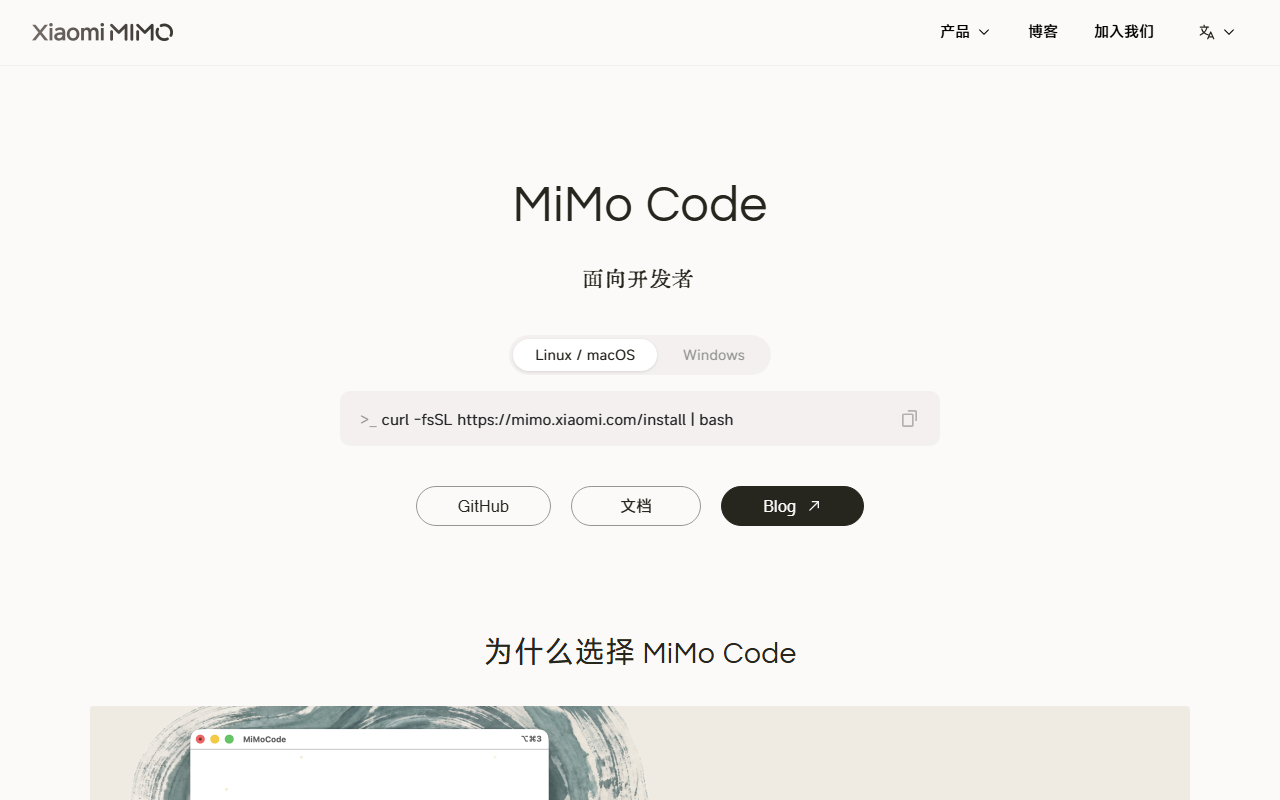
- Mac and Linux: run
curl -fsSL https://mimo.xiaomi.com/install | bash - Windows: run
npm install -g @mimo-ai/cli
Launch and Configuration
After installation, type mimo in the terminal to launch. For the best experience, use it in iTerm or the VS Code terminal. Type / to view all configuration options; a persistent status panel on the right side of the TUI shows your progress in real time.
Using Compose Mode
Press Tab to switch to Compose mode, then enter a simple idea. The AI will work through design, planning, coding, testing, and review in order.
Triggering Memory Consolidation
Use the /dream command. Every 7 days, the system automatically organizes historical sessions, merges duplicates, and updates global memory.
Voice Control
Dictate prompts directly or say operational commands such as “send” and “execute.” Speech recognition is provided by MiMo-V2.5-ASR.
Switching Models
The built-in MiMo-V2.5 channel is currently free for a limited time and requires no registration. In the configuration, you can also add API keys for DeepSeek, Kimi, GLM, or a third-party token plan.
Code Review and Editing
Let the AI automatically analyze the codebase structure, make safe edits, generate diffs, and run checks to catch potential issues before merging.
Key Advantages
- A unique persistent memory system: three-tier memory plus a dedicated subagent, without relying on the model to take notes by itself.
- Model–agent co-optimization: a purpose-built harness system tailored to MiMo-series models, deeply adapted to model characteristics and the agent framework; measured performance with the same model is better than Claude Code.
- Compose end-to-end mode: one-click completion of the whole development pipeline, from design to review.
- Dream self-evolving memory: every 7 days, project understanding is automatically consolidated.
- Strong cost-effectiveness: built-in MiMo-V2.5 is currently free for a limited time; API pricing from 0.7 CNY per million tokens; Token Plan from 1,188 CNY per year.
- Full voice control: based on MiMo-V2.5-ASR, the entire workflow can be driven by voice.
- Open source with zero barriers: MIT license — individuals can modify and redistribute freely, and companies can integrate it into their own toolchains at no cost.
- Full Chinese localization: all configuration items are localized in Chinese, with stable direct connectivity on China's domestic networks and a real-time progress panel on the right.
- Long-context support: the MiMo-V2.5 series supports a 1M context window, making it easy to handle large codebases and complex cross-file tasks.
- Measured performance leadership: in the SWE-Bench and Terminal Bench real-world coding tests, same-model comparisons show results comprehensively ahead of Claude Code.
Use Cases
- Daily coding for individual developers: use Compose mode to quickly turn feature requests into implementations, with the full flow from design to testing automated — a good fit for independent developers shipping projects efficiently.
- Large-codebase maintenance and refactoring: the 1M long context and persistent memory system make it easy to understand complex cross-file dependencies and safely perform large-scale refactors.
- Rapid full-stack scaffolding: enter a simple idea and MiMo Code automatically plans the frontend and backend architecture, generates code, and ships complete tests — well suited to MVP prototyping and project kickoff.
- Code review and quality assurance: it automatically checks diffs, runs tests, and catches potential issues before code is merged, acting as an “AI reviewer” to lower the risk of bugs in production.
- Voice-driven development scenarios: built-in ASR supports end-to-end voice input and control, suited to developers who want to free their hands, pursue maximum efficiency, or have keyboard operation difficulties.
- Open-source community and vertical tooling: the MIT license allows free modification and redistribution, so the community can build specialized coding assistants for specific languages (such as Rust and Go) or domains (such as embedded systems and blockchain).
Pricing and Verification
MiMo Code's built-in MiMo-V2.5 is currently free for a limited time. API pricing is as low as 0.7 CNY per million tokens, and Token Plans start at 1,188 CNY per year. These prices, free allowances, and availability are subject to change. Visit the official website (https://mimo.xiaomi.com/mimocode) to verify the latest policy before purchasing or using.
FAQ
Is MiMo Code free?
MiMo Code itself is open source under the MIT license, so individuals and companies are free to use, modify, and redistribute it. The built-in MiMo-V2.5 channel is currently free for a limited time; refer to the official website for the latest terms.
Which third-party models are supported?
In addition to MiMo-V2.5, MiMo Code supports mainstream models such as DeepSeek, Kimi, and GLM, as well as third-party token plans.
How do I install MiMo Code on Windows?
Windows users can install globally with npm install -g @mimo-ai/cli.
How do I trigger memory consolidation?
Use the /dream command in the terminal. The system automatically organizes, merges, and deduplicates historical sessions every 7 days.
Which operations does voice control support?
It supports dictating prompts, modifying instructions, and sending or executing commands by voice, with recognition handled by MiMo-V2.5-ASR.
Alternatives
- Claude Code: the AI coding assistant used in the official comparative tests on the SWE-Bench and Terminal Bench real-world coding benchmarks.
- Cursor: the overseas AI coding tool referenced in official pricing comparisons, where MiMo Code is positioned as offering better value for money.
(The alternatives above are not official recommendations; they serve only as references for comparing similar tools.)
Official Resources
- Official website: https://mimo.xiaomi.com/mimocode
- GitHub repository: https://github.com/XiaomiMiMo/MiMo-Code
Frequently asked questions
Is MiMo Code free?
MiMo Code itself is open source under the MIT license, so individuals and companies can use, modify, and redistribute it for free. The built-in MiMo-V2.5 channel is currently free for a limited time; see the official website for the latest details.
Which models does MiMo Code support?
Besides the built-in MiMo-V2.5 model, MiMo Code supports mainstream models such as DeepSeek, Kimi, and GLM, as well as third-party token plans.
How do I install MiMo Code?
Mac and Linux users can run curl -fsSL https://mimo.xiaomi.com/install | bash for one-click installation; Windows users can install globally with npm install -g @mimo-ai/cli.
How does MiMo Code's memory feature work?
The system automatically saves state through a dedicated subagent. Using the /dream command, it consolidates historical sessions and updates global memory every 7 days.
Does MiMo Code support voice control?
Yes. Powered by MiMo-V2.5-ASR speech recognition, you can dictate prompts, modify instructions, and send or execute commands by voice without touching the keyboard.