
YinChao is an AI music creation platform. You submit an idea as a text description, an uploaded image or a hummed melody; the platform returns a complete song in roughly 15 seconds to one minute, with controls for genre, instrumentation and emotional tone. Output is stereo audio generated by an in-house Diffusion Transformer model, and a music API covers multimodal generation, voice cloning, continuation and smart mixing.
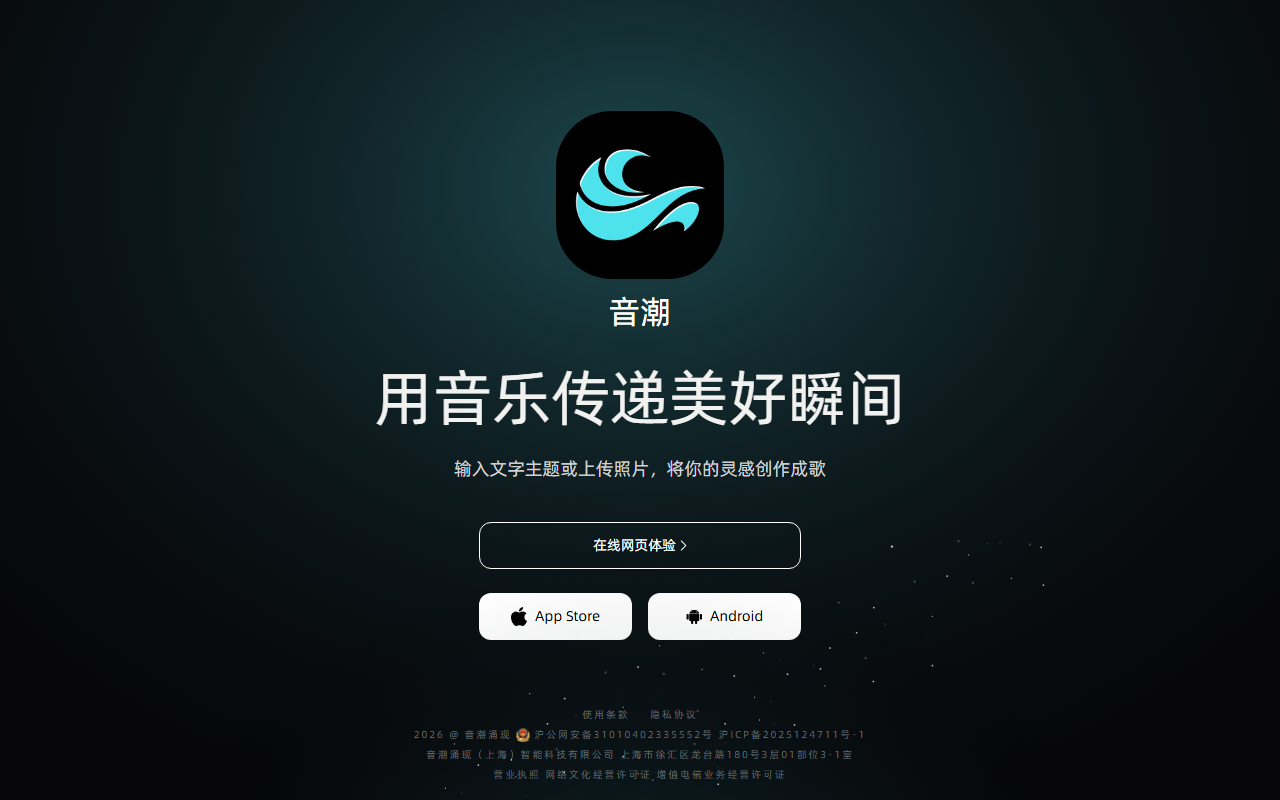
YinChao: a self-developed AI music platform that turns an idea into a full song in 15 seconds to one minute
YinChao is an AI music creation platform with a fully in-house stack, positioned around one goal: getting an idea to a listenable, complete song as fast as possible. It takes three kinds of input - a written description, an image, or a hummed melody - and returns a finished track with vocals and arrangement. The stated generation time is 15 seconds to one minute, fast enough that iterating on several directions becomes the normal workflow rather than a luxury.
Most text-to-music tools assume your idea already exists in words. YinChao also accepts images and humming, which map onto the two most common real starting points in music making: you have a visual mood and need something that fits it, or you already have a melodic motif in your head but no way to arrange it. Treating humming as a first-class input is an admission that a motif a person invented is often closer to the creative act than a well-written prompt.
On the technical side, the company built its own music models and emphasises multimodal representation and high-fidelity reconstruction, with a self-developed Diffusion Transformer (DiT) model generating the audio. The stated output characteristic is stereo audio with natural width and depth - a sound field closer to a finished production than a mono melodic sketch. Beyond the consumer product, a music API exposes multimodal generation, voice cloning, music continuation and smart mixing so teams can embed music generation into their own products.
Key features
Three input modes
Text, image and humming sit side by side. Text suits describing genre and use case, an image suits deriving mood and instrumentation from a visual atmosphere, and humming suits handing an existing motif to the model for full arrangement. Pick whichever matches what you actually have instead of forcing everything into a prompt.
Fast full-track generation
The official figure is 15 seconds to one minute for a complete song. The value is less about speed than about making iteration normal: generating four or five directions from one motif and continuing with the best one is closer to real production than trying to nail it in a single pass.
Parameter controls
Genre, instrumentation and emotional tone can be adjusted. Parameters are reproducible and easy to nudge, but the freedom is bounded by the dimensions the platform exposes; finer control usually means working through lyrics, structure and descriptive wording.
Stereo audio from a DiT model
Audio is rendered as stereo with natural width and depth, which matters for content consumed on headphones and small speakers - short video, podcasts, games - where spatial impression carries much of the immersion.
Creator community
A space for showing work, exchanging experience and collaborating, plus platform activities and challenges. Beyond distribution, the community is a sample of what styles are actually being listened to right now.
Music API
An interface for developers and businesses supporting multimodal generation, voice cloning, music continuation and smart mixing. Cloning and continuation are engineering capabilities rather than composition skills, which suits teams adding music features to an existing product.
Copyright detection
A built-in check for originality and legal risk. The realistic failure mode in generated music is a result that sits too close to a known work, and detection surfaces that early - though it is not a substitute for legal advice.
How to use it
- Open the YinChao website and use it in the browser, or install the mobile app, then register and sign in.
- Choose an input mode: describe the idea in words, upload an image, or record a hummed melody.
- Submit the material. In a description, state the use case, mood and instrumentation first; stacking genre adjectives is less effective than being concrete.
- Adjust genre, instrumentation and emotional tone to narrow the result toward what you want.
- Generate and wait 15 seconds to one minute, then listen. If it misses, change parameters and regenerate rather than editing the result heavily.
- Edit the generated track - melody, rhythm, harmony - until the structure and emotional arc match the intent.
- Save to the platform or locally, then decide whether to share to the community; run a copyright check before any commercial use.
- Browse community work and platform activities to see how others handle similar material, and use that to plan the next revision.
Pricing and licensing
- The source does not publish subscription prices, per-song generation costs, free quotas or commercial licensing terms, and gives no API billing details or rate limits.
- Commercial usage scope, copyright ownership of generated tracks and redistribution conditions are exactly the things to confirm before use, and the source does not address them.
- If the music is headed for advertising, film or a game release, verify the licence scope with the platform first rather than assuming that generating a track grants full rights.
Where it fits
- Personal projects: people without theory or arrangement background can turn a hum or a paragraph into a complete song to mark a moment or capture a mood.
- Content production: video creators and independent publishers generate background music that follows the pacing of a cut, avoiding the familiarity of stock libraries.
- Advertising and marketing: custom tracks for brand films and campaign spots, aligned to tone and mood while shortening the search-and-licence cycle.
- Games and film: sketch several scoring directions for a scene or storyboard to settle mood and tempo before committing to full production.
- Music education: generate different arrangements of the same motif so students hear directly what a change in instrumentation or style does.
- Product integration: developers add generation, voice cloning, continuation and mixing into their own applications through the API.
Limitations to know
- Free quotas, subscription tiers and API pricing are not disclosed; confirm real capacity inside the platform instead of inferring cost from marketing copy.
- The 15-second to one-minute figure is the stated generation time; actual latency depends on track length, concurrency and network, so budget waiting time for batch work.
- Parameter control covers genre, instrumentation and emotional tone; mix detail, specific performance techniques and fine structural edits still need post-processing.
- Copyright detection flags similarity risk but is not a legal conclusion; verify licensing and platform terms yourself before commercial release.
- Voice cloning raises rights issues when the voice belongs to someone else - availability of the feature does not make the use lawful without permission.
- Outputs can converge stylistically; the same prompt set tends to produce similar arrangements, so serious projects should combine generated material with human arrangement or reworking.
FAQ
Do I need music theory to use it?
No. Humming and image input require no theory, and a description can be written in everyday language about use case and mood. The real difficulty is judging the result, which takes listening and comparing several parameter settings.
Does humming input require accurate pitch?
The source does not specify pitch or timing accuracy requirements. In practice humming conveys melodic direction and rhythmic feel; being off-key usually does not stop the model from reading the motif, but a clear, well-phrased hum tends to yield a more complete arrangement.
Can generated songs be used commercially?
The source gives no licensing terms, so this cannot be confirmed. The presence of copyright detection suggests the company is aware of originality issues, but commercial scope, ownership and redistribution still need to be confirmed with the platform.
How long does one song take?
Officially 15 seconds to one minute. Real working time should include listening, adjusting parameters and regenerating; a version you are happy with is usually the product of several passes, not one click.
How is it different from text-only tools?
The difference is on the input side. Text-only tools ask you to translate an idea into words, while image and humming inputs remove part of that translation. For anyone who already has a motif, humming is often faster than writing an accurate genre description.


Frequently asked questions
Do I need music theory to use it?
No. Humming and image input require no theory, and a description can be written in everyday language about use case and mood. The real difficulty is judging the result, which takes listening and comparing several parameter settings.
Does humming input require accurate pitch?
The source does not specify pitch or timing accuracy requirements. In practice humming conveys melodic direction and rhythmic feel; being off-key usually does not stop the model from reading the motif, but a clear, well-phrased hum tends to yield a more complete arrangement.
Can generated songs be used commercially?
The source gives no licensing terms, so this cannot be confirmed. The presence of copyright detection suggests the company is aware of originality issues, but commercial scope, ownership and redistribution still need to be confirmed with the platform.
How long does one song take?
Officially 15 seconds to one minute. Real working time should include listening, adjusting parameters and regenerating; a version you are happy with is usually the product of several passes, not one click.