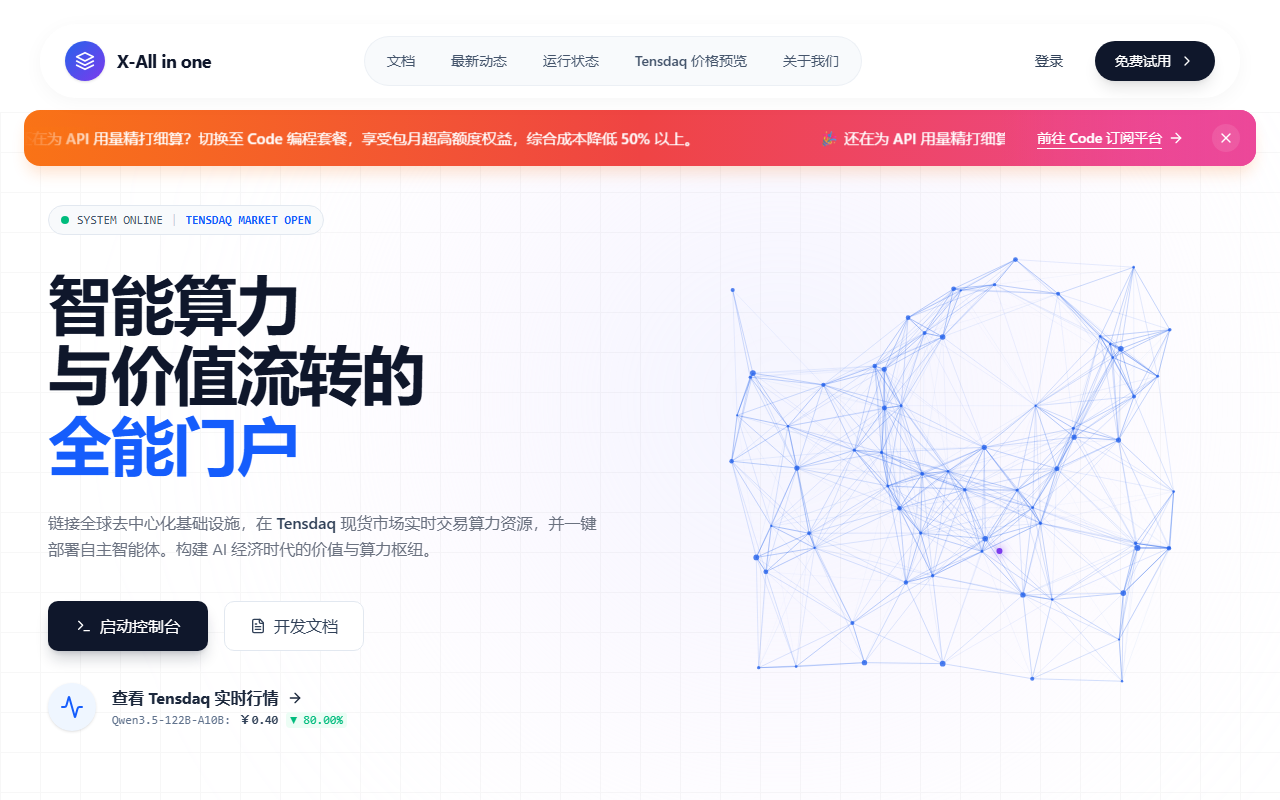
X-All in one is a self-developed AI API platform. It lets you call multiple models through one interface and use Tensdaq, a bidding service where you set the maximum price per million tokens.
What is X-All in one
X-All in one is a self-developed AI API platform that puts model access, compute scheduling and billing management into a single service. According to official material, the underlying infrastructure runs on national-grade computing capacity from the three major telecom carriers, and everything from low-level scheduling to the API delivery layer is built in house, giving elastic scaling and cross-region dispatch that follows traffic demand.
For users, the platform has two practical anchors: calling multiple models through one unified interface, and using Tensdaq, a bidding mechanism that lets you name your own inference price. Official figures claim a first-packet response time 30% faster than the industry average, model pricing at about 80% of the market average, and actual usage cost more than 20% lower. These numbers come from the vendor, and real results vary by model, time of day and region, so it is worth running a small batch of requests before committing.
Main capabilities
Tensdaq bidding AI MaaS: The name combines Tensor and Nasdaq. Instead of a flat per-token price, you state the maximum you are willing to pay per million tokens. The platform uses this to shift demand away from peaks: large jobs that are not latency-critical can be scheduled into cheaper hours.
In-house compute scheduling engine: A self-developed distributed scheduler allocates compute resources under high concurrency and reduces the chance of service interruption.
High-performance API: Designed around first-packet latency, it targets latency-sensitive interactions such as real-time chat and streaming output.
All-in-one developer console: A visual dashboard for request monitoring and usage analytics, with volume, request counts and cost visible in one place.
Unified multi-model management: Different models can be mixed inside the same project, without maintaining separate credentials and integration code for each provider.
Security: The vendor describes TLS and RSA transport encryption, staged encrypted inference, and permission controls for resource isolation.
Getting started
- Register and claim credit: Visit https://www.x-aio.com/ and sign up; the official documentation says 20 yuan of starting credit is granted automatically and can be spent on the bidding API.
- Get an API key: Log in to the console and create and copy your dedicated API key.
- Integrate: Configure the key in your agent or application and call the standard API.
- Enable bidding: Open the Tensdaq page, review the list of models that currently support bidding, read the bidding terms, and activate the bidding API.
- Set your bid: Find the target model in Tensdaq and enter the maximum you will pay per million tokens. Bidding is priced on input; output is charged at a fixed multiple determined by the model type.
- Wait for it to take effect and review: After each hour passes, the new price is applied. The API price history view shows up to 24 hours of changes, including hourly averages and peak and trough values.
- Call and monitor: Select the Tensdaq API endpoint when calling, then keep watching usage and performance metrics in the console and adjust bids and configuration as needed.
The vendor's own practical tip is to start with a bid about 10-15% above the market average for stability, then lower it gradually once you see how it behaves.
Use cases
Agent development: Complex reasoning chains involve many sequential calls and are sensitive to both latency and concurrency. A unified endpoint plus elastic compute keeps response times stable during traffic peaks.
Enterprise AI integration: Support bots, content generation platforms and data analysis assistants often need several models at once to balance quality against cost; unified management and usage analytics simplify that engineering work.
Individual developers and research: Pay-as-you-go combined with bidding lets solo projects, startups and academic work validate ideas at a controlled cost, with no large upfront commitment.
Limitations and cautions
The published performance and cost figures (30% faster first packet, 80% of market pricing, over 20% lower cost, average issue resolution under two hours, core team averaging more than six years of industry experience) are vendor claims without independent third-party benchmarking, so base your decision on your own measurements.
Bidding trades certainty for price: whether your bid clears depends on supply and demand at that moment, and the price can move every hour, so it does not fit production paths with hard response-time or availability commitments. If your service needs strict guarantees, evaluate the fixed-price option first or prepare a fallback.
The exact amount, scope and validity of the registration credit follow the latest official terms; the model list, supported SDK languages and regional availability can also change, so confirm current details on the official site and in the API documentation before integrating. Transport and inference encryption reduce exposure, but workloads with sensitive data still need their own compliance review.
FAQ
Who is X-All in one for? It suits developers and companies that manage several models behind one interface and care about inference cost, especially agent building, customer support and content generation workloads.
How does Tensdaq bidding work? You set a maximum price per million tokens; the price takes effect on the hour and the platform matches supply and demand. Output is billed at a fixed multiple set by model type. A first bid about 10-15% above the market average is recommended.
Is there a free credit for new users? The official documentation states that 20 yuan in starting credit is granted automatically after registration and can be used with the bidding API. Scope and validity follow the rules published on the official site.
Frequently asked questions
Who is X-All in one for?
It suits developers and companies that manage several models behind one interface and care about inference cost, especially agent building, customer support and content generation workloads.
How does Tensdaq bidding work?
You set a maximum price per million tokens; the price takes effect on the hour and the platform matches supply and demand. Output is billed at a fixed multiple set by model type. A first bid about 10-15% above the market average is recommended.
Is there a free credit for new users?
The official documentation states that 20 yuan in starting credit is granted automatically after registration and can be used with the bidding API. Scope and validity follow the rules published on the official site.