TokenPony suits individual developers, small teams, enterprise users and researchers who need several large models at the same time, do not want to build their own GPU servers, and prefer a unified interface that simplifies integration.
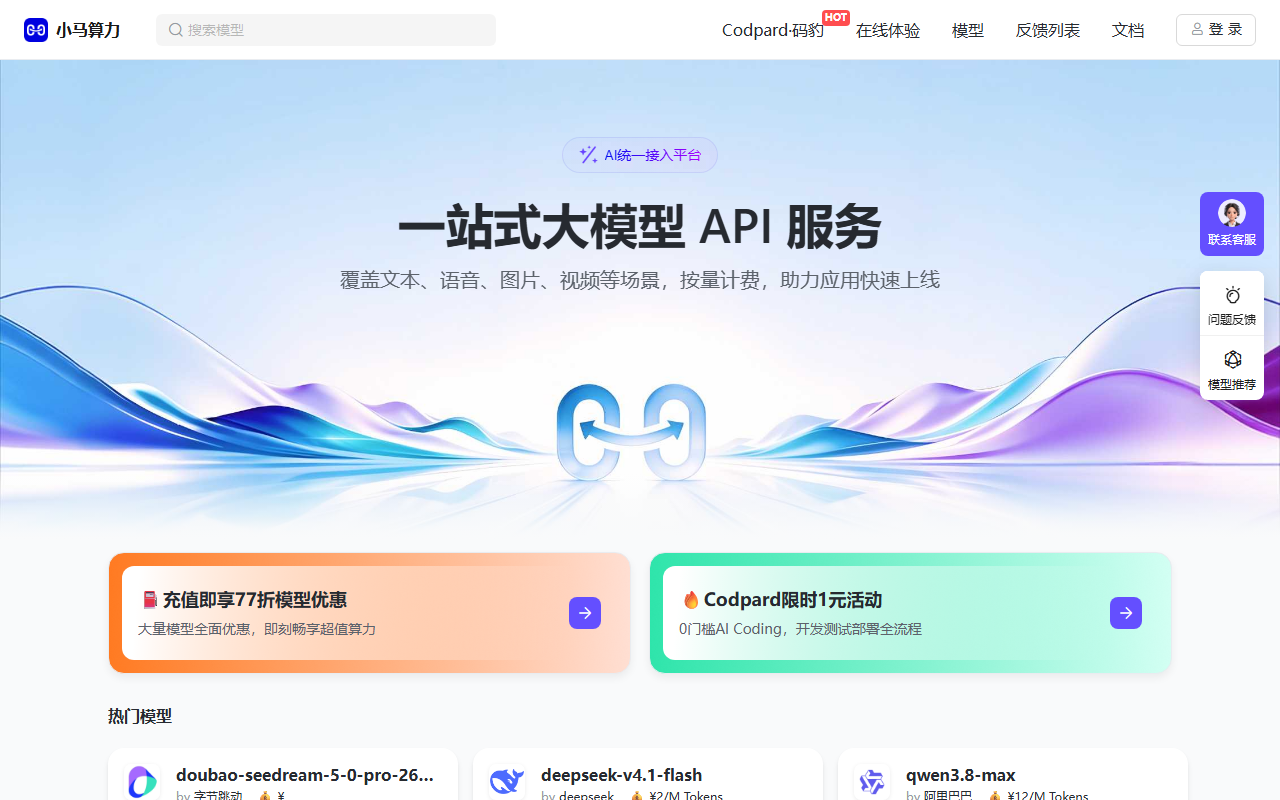
TokenPony: An API Aggregation Platform with a Unified Interface for Large Model Calls
TokenPony is an AI model API aggregation platform designed for individual developers and small teams. Its position can be compared to an orchestration layer: it brings mainstream large models such as DeepSeek, Kimi, Qwen and GLM together under one interface, so users do not have to switch repeatedly between multiple providers. For developers, what usually consumes the most effort is not "calling a model once", but the integration, authentication, billing and maintenance cost when several models are used at the same time. This platform gathers all of that into one place and also provides 1024K ultra-long context support for long documents, multi-turn conversations and complex Agent tasks, without requiring you to build your own GPU servers.
Key Features
Access to all models Integrates mainstream large models such as DeepSeek, Kimi, Qwen and GLM. Users do not need to switch across platforms and can freely call different models on the same platform. For applications that rely on several models at once, this removes the trouble of repeated integration.
Ultra-long context support Provides 1024K context capacity, usable for long documents, multi-turn conversations and complex Agent tasks. Context length directly determines how much material can be included in a single request, which is a prerequisite for long-form tasks.
One-click API calls Zero configuration and no deployment required — integrate and go live. Developers do not need to handle service deployment or runtime environment setup; once they have the key, they can start calling.
No GPU server needed You use the APIs of already-trained models, so there is no need to build your own GPU servers and the hardware cost is saved. For individual developers and small teams, this is often the most decisive factor.
Cost optimization Provides a transparent pricing mechanism so you can trade off between performance and cost. Unit costs differ noticeably across models, and clear pricing helps you keep overall spending under control.
Steps to Use
- Register and sign in: Visit the product website and complete registration through the sign-in entry at the top right of the page.
- Browse the models: Go to the model page to see the list of supported models, and use the filtering function to find the details of a specific model.
- Top up: Choose top-up under "User Information". WeChat Pay is currently supported, with a minimum top-up amount of 10 yuan, used to cover subsequent model calls.
- Create an API Key: On the model page, select the model you need to configure, and an API Key can be created for that model.
- Call the API: Use the created API Key to call the desired model through the platform interface and start your development work.
- Manage usage: Estimate the call volume per project and combine it with the pricing of different models to choose a suitable model, avoiding unnecessary consumption.
Who It Is For
- Individual developers: Want fast access to multiple large models, simplify the development process and reduce development costs
- Small teams: Need to make efficient use of limited resources and quickly build and deploy large-model-based applications
- Creative workers: Such as copywriters and content creators, who need AI to improve creative efficiency and quality
- Enterprise users: Want to integrate AI capabilities into their business without investing heavily in building their own models and infrastructure
- Researchers: Need to flexibly call different models for research and experiments, exploring new AI application scenarios
- Students and educators: For learning and teaching, exploring AI applications in the field of education
Limits and Notices
- Model capabilities and parameters are subject to the versions actually provided by the platform; different models differ in output quality, speed and context limits.
- An aggregation interface does not change the output quality of the models themselves; the accuracy of important tasks still needs to be evaluated and verified by you.
- Calls are billed by usage, and long contexts and high-frequency calls will significantly increase costs, so estimate based on actual usage.
- An API Key is a credential. Keep it safe and avoid leaking it or committing it to public code repositories.
- An internet connection and platform availability are required; service adjustments or outages will affect the call chain.
- Top-ups, payment methods, prices and any offers follow the actual pages of the platform; please confirm the current rules before use.


Frequently asked questions
What problem does TokenPony solve?
TokenPony brings mainstream large models such as DeepSeek, Kimi, Qwen and GLM together under one interface, avoiding the hassle of switching platforms and integrating each one separately. It also provides 1024K ultra-long context for long documents, multi-turn conversations and complex Agent tasks, and requires no self-built GPU servers, which lowers hardware cost.
How do I call models on TokenPony?
The basic flow is: register and sign in, browse the supported models on the model page, top up via User Information, create an API Key for the model you need on the model page, and then use that key to call the API through the platform interface. Top-ups currently support WeChat Pay with a minimum amount of 10 yuan.
What should I keep in mind when using an API aggregation platform?
Keep in mind that different models differ in quality, speed and context limits, and an aggregation interface does not change the output quality of the models themselves. Calls are billed by usage, so long contexts and high-frequency usage raise costs considerably. Treat the API Key as a credential and never commit it to a public repository. An internet connection and platform availability are required, and prices and rules follow the actual platform pages.