
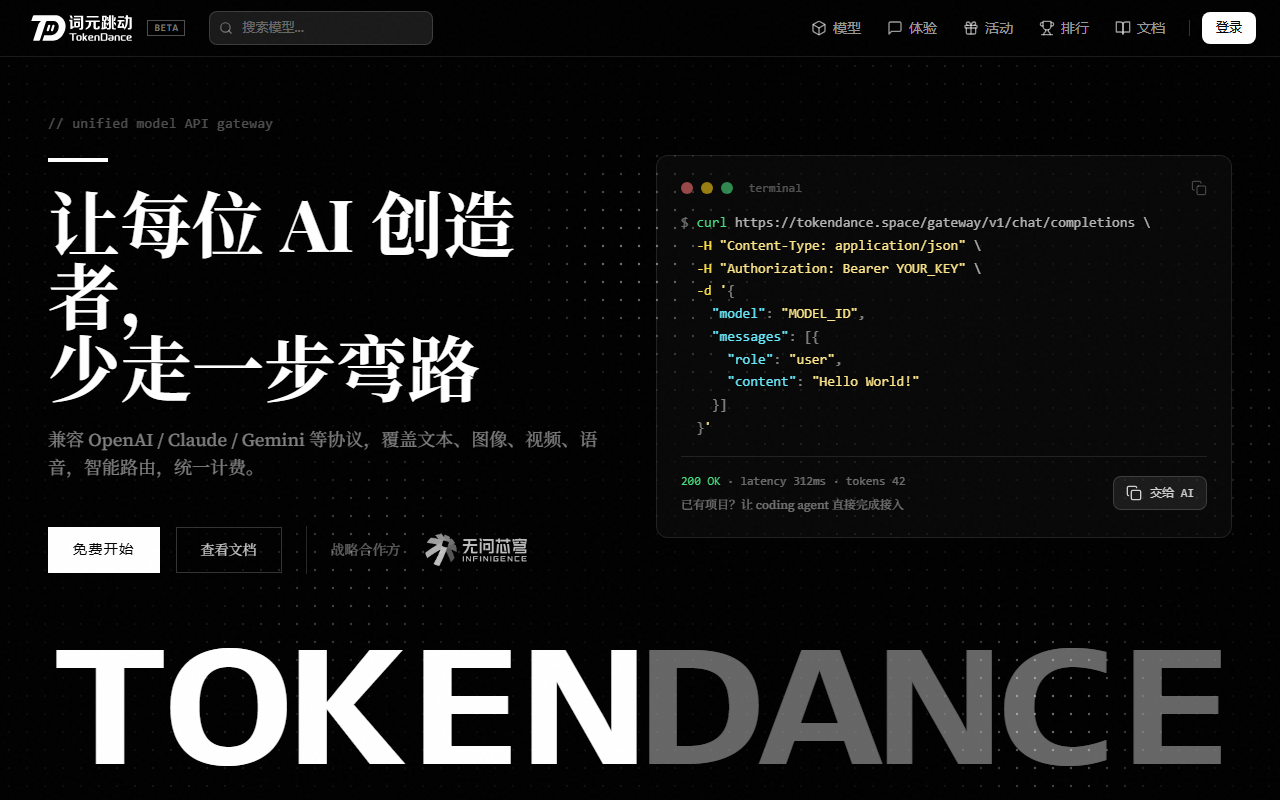
TokenDance is an LLM API aggregation gateway. It natively supports the OpenAI, Claude and Gemini protocols: replace the Base URL with the gateway address, add an API key and a model ID, and your existing SDK calls reach MiniMax, Qwen, Kimi, Zhipu, DeepSeek and other Chinese models. Smart routing, unified cross-provider billing and multi-endpoint failover come with it, and no business code changes are required.
TokenDance: one Base URL for several Chinese LLM providers
Anyone building an AI product goes through the same phase: connect one provider to prove the flow, then a second and a third for quality or cost. Soon the codebase carries an adaptation layer, keys are scattered across dashboards, invoices live in separate accounts, and when one provider wobbles someone switches endpoints by hand. TokenDance targets that layer of friction: one Base URL in front of several providers, with the application seeing a single entry point.
The mechanism is not exotic. It exposes three mainstream protocol shapes — OpenAI, Claude and Gemini — and routes internally by model name to the matching provider endpoint. Developers change configuration rather than code, which is what makes the zero-migration claim plausible. For a project already on the OpenAI SDK, one line of Base URL is enough to try a Chinese model, so the cost of experimenting drops sharply.
The rest of the value sits on the operations side. With several endpoints configured for the same model, a single-provider outage can fail over automatically; a request can also list candidate models and degrade step by step when the primary is unavailable. Unified billing rolls cross-provider token usage into one invoice, which saves separate top-ups and reconciliation. The source does not disclose rates, rate limits, SLA commitments or data retention, so confirm those before committing.
Main features
Protocol compatibility
Native support for the OpenAI, Claude and Gemini protocols means switching the Base URL is enough; existing business code stays as it is. For legacy projects this is the most practical part: trying a new model does not require rebuilding the call layer.
Smart routing
Requests route by model name to the right provider endpoint, hiding scheduling details behind one entry. Callers no longer track each provider's hostnames and parameter quirks.
Unified billing
Token consumption is counted across providers and billed in one place, so there is no topping up five dashboards. When a team attributes cost, one invoice is easier to explain than five.
Failover and degradation
The same model can have several provider endpoints with automatic switching, and one request can name several candidate models to fall back through. This is the most concrete advantage a gateway has over direct integration.
Model coverage
More than eight Chinese flagship models are connected, including MiniMax, Qwen, Kimi, Zhipu and DeepSeek, with more being added. The coverage is Chinese mainstream models, not a global catalogue.
Quick start
Registration and verification run through Watcha one-click login, and existing SDKs keep working, so onboarding takes minutes. That login ties you to a specific account system, which is a precondition to accept.
Subsidy programme
An application form offers token sponsorship by product stage. Useful for early projects, though the amount and approval criteria are not published.
Getting started
- Open the TokenDance site and register through Watcha one-click login to verify the account.
- Generate a personal API key in the console and store it like any other credential.
- Replace the Base URL in your project with the gateway address https://tokendance.space/gateway/v1/.
- Fill in the target model ID in the request, for example DeepSeek or Kimi.
- Send the request with your existing OpenAI SDK or curl and check that the response matches expectations.
- If you need a large volume of tokens, submit the subsidy application form and request sponsorship by product stage.
Who it fits
- Startup teams comparing several Chinese models cheaply through one gateway before committing.
- Products that route by task type in production, sending reasoning, writing and coding work to different models.
- Agent systems that need a high-availability, degradable model layer underneath.
- Cost-sensitive education, research and solo developers relying on unified billing and sponsorship.
Limitations
- Rates, free quota, rate limits and service-level commitments are not disclosed; confirm with the vendor before integrating.
- Accounts require Watcha one-click login, so you accept that account system; enterprise identity integration is not described.
- The gateway sees request content, and data retention or logging policy is not stated, so assess compliance for sensitive data.
- The catalogue focuses on Chinese mainstream models; global or niche open models may not be covered.
- An extra hop adds latency and one more failure point. Failover helps, but you still need your own monitoring.
- Sponsorship amounts, criteria and continuity are unpublished; do not build a long-term cost model on them.
FAQ
Do I need to change code?
Not business code. Replace the Base URL with the gateway address, add the API key and model ID, and keep using the OpenAI SDK as before.
Which models are available?
The source lists more than eight Chinese flagship models including MiniMax, Qwen, Kimi, Zhipu and DeepSeek, with more being added. The console holds the authoritative list.
How does failover work?
Two layers: several provider endpoints per model with automatic switching, and per-request candidate models that degrade in order when the primary fails.
How is it different from calling providers directly?
Direct integration means managing keys, top-ups, rate limits and failover per provider. A gateway centralises them in one entry and one invoice, at the cost of an extra hop and dependence on the gateway itself.
Is there a free tier?
The source only mentions a sponsorship programme applied for by product stage, with no regular free quota stated. Ask the vendor.
Frequently asked questions
Do I need to change code?
Not business code. Replace the Base URL with the gateway address, add the API key and model ID, and keep using the OpenAI SDK as before.
Which models are available?
The source lists more than eight Chinese flagship models including MiniMax, Qwen, Kimi, Zhipu and DeepSeek, with more being added. The console holds the authoritative list.
How does failover work?
Two layers: several provider endpoints per model with automatic switching, and per-request candidate models that degrade in order when the primary fails.
How is it different from calling providers directly?
Direct integration means managing keys, top-ups, rate limits and failover per provider. A gateway centralises them in one entry and one invoice, at the cost of an extra hop and dependence on the gateway itself.