Teamo is a multi-agent AI product from the Xixiaoyao team, positioned as an A2A-paradigm super agent for knowledge workers. It handles complex tasks as a simulated team: a CEO Agent directs search, consulting, writing, and design groups staffed by different AI models, running task understanding, planning and decomposition, multi-source retrieval, cross-validation, analysis, and structured generation end to end. You interact with each role and can step in at any point, watching progress, retrieved sources, and drafts in real time; SWOT, business plan, and academic paper templates constrain the output, and group leads score members' work so you can choose among evaluated candidates.
Teamo: an A2A multi-agent setup that turns one report into a small virtual team
Teamo is a multi-agent AI product from the Xixiaoyao team, described by its maker as an A2A-paradigm super agent built for knowledge workers. The idea is not to make one model stronger but to split a task across a simulated team: a captain agent directs search, consulting, writing, and design groups, each staffed by different models, and the pieces are assembled into one deliverable. You manage agents by role and give them instructions or corrections, rather than rewriting one prompt in a chat box.
The bottleneck in complex knowledge work is usually not the writing. It is the work in front of it: deciding what to look for, where to look, which sources contradict each other, and which numbers need cross-checking. Compressed into a single conversation, a model tends to skip verification and produce a confident answer, leaving you no way to see where it went wrong. Teamo makes that chain explicit, running task understanding, planning and decomposition, multi-source retrieval, cross-validation, analysis, and structured generation as separate steps handled by matching agents.
The second design emphasis is visible process. You can watch each agent's progress, what it retrieved, what analysis it ran, and what the draft looks like. That directly targets the hallucination problem in AI writing: instead of demanding that the model never errs, it creates opportunities to catch an error mid-flight. It also means you can intervene, redirect, add material, or reject a step before the final output is assembled.
The third emphasis is model heterogeneity. Groups are staffed by different models, dispatching text, data, image, and code capabilities by scenario, and group leads score their members' output so competing candidates can be compared and the best chosen. Whether this genuinely raises quality depends on the routing policy, but structurally it offers something a single chat cannot: several comparable candidates and a hierarchy that can point at a weak step.
What Teamo does
Multi-agent collaboration
A simulated team structure: a captain agent (CEO Agent) directs search, consulting, writing, and design groups whose members are different AI models working on separate parts of one task.
Search-and-write pipeline
An end-to-end path from task understanding and decomposition through multi-source retrieval, cross-validation, and analysis to structured generation, aimed at reports, market analyses, and academic drafts that need evidence behind them.
Role-based interaction
You talk to a specific function rather than a generic assistant, issuing instructions or refinements to the role responsible, which feels closer to managing a team than tuning parameters.
Transparent, traceable workflow
Progress, retrieved sources, analysis steps, and drafts are visible in real time, so the question of how a conclusion was reached is answered during the run rather than after it.
Cross-modal scheduling
Text, data, image, and code models are dispatched and combined per scenario, with multiple tasks issued at once, cutting the cost of switching between separate tools.
Structured output templates
Built-in templates for SWOT analysis, business plans, and academic papers constrain format and fields so the structure does not have to be re-specified every time.
Iteration and automatic evaluation
You can step in at any point to change direction or add information, and agents can compete head-to-head with group leads scoring members so you pick from evaluated candidates.
How to use it
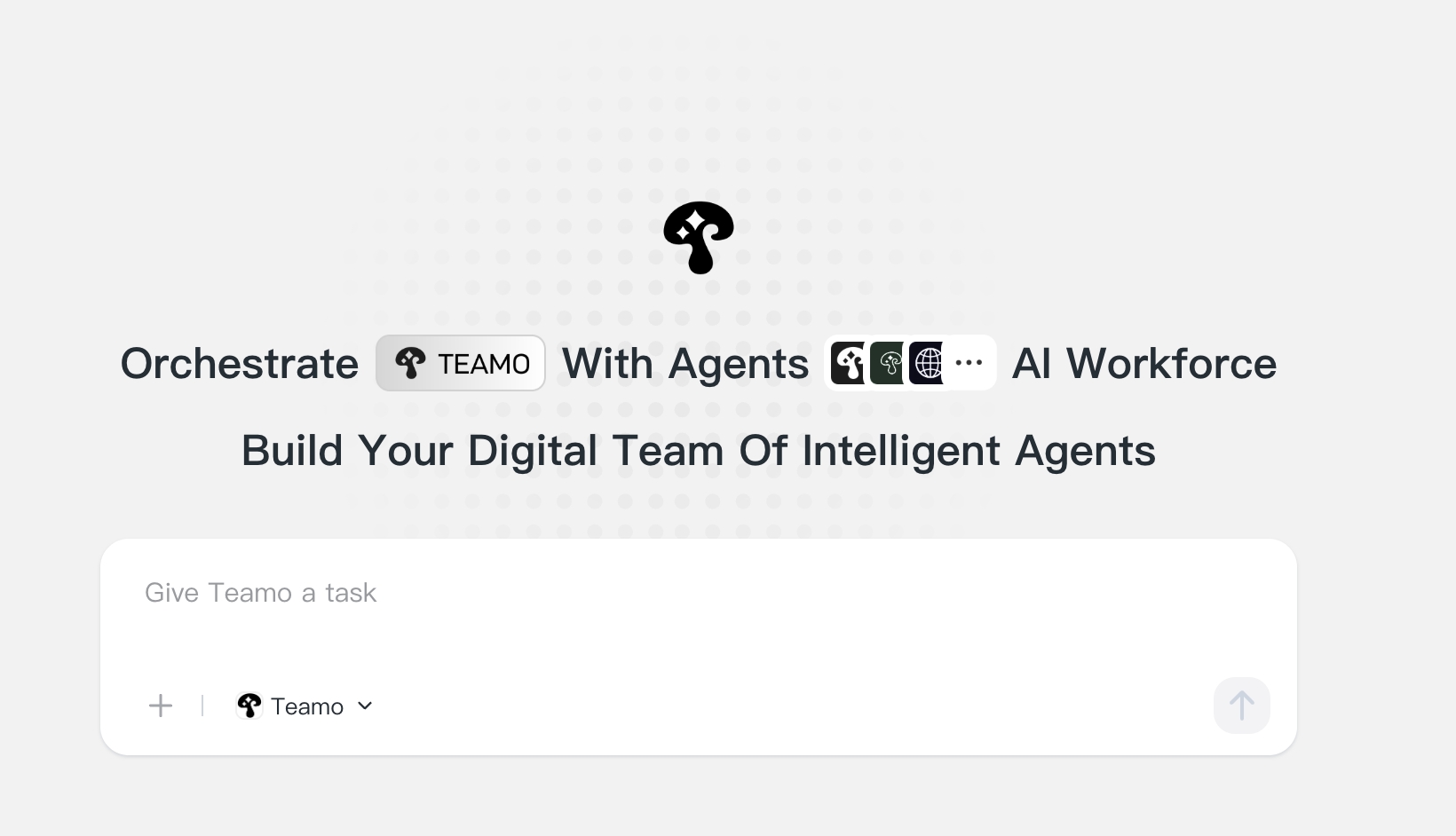
- Open the official site, register, and sign in to reach the task input screen.
- Describe the task the way you would brief a colleague, and attach relevant files or images for multimodal handling. The clearer the brief, the better the decomposition.
- Choose the agent group that matches the work: search for gathering material, consulting for judgement, writing for drafting, design for presentation.
- Watch the process panel while it runs, focusing on whether sources look credible and whether cross-validation actually happened, and intervene where it did not.
- Refine the result or ask the lead for another evaluation round. The template has already fixed the structure, so spend your remaining effort on verifying facts.
Pricing and access
- The source page discloses no subscription price, free quota, or credit-based billing, and does not say whether routing to different models changes cost.
- The confirmed entry point is the official site, which requires registration and sign-in; whether a trial is offered is not stated in the source.
- This article does not speculate about pricing or plan tiers.
Who it suits
- Knowledge workers producing long documents with an evidence trail, such as research reports, market analyses, or competitor comparisons, since those tasks are inherently multi-role.
- Writers and editors who can run topic selection, source gathering, and drafting in one pipeline while still seeing where the material came from.
- Decision-support and research teams that need structured templates and a traceable process rather than an unverifiable conclusion.
Limits to know first
- The claim of being the world's first A2A-paradigm super agent is the vendor's positioning, and the source offers no verifiable comparison.
- Agents evaluating each other can surface problems but do not guarantee correctness; key figures still need checking against the original source.
- Pricing, concurrency limits, data storage, and privacy policy are not disclosed, so enterprise users must confirm compliance themselves.
- The more elaborate the pipeline, the higher the time and cost; a simple question is usually faster in a single chat.
Frequently asked
How is A2A different from ordinary multi-agent setups?
The emphasis is on agent-to-agent collaboration in which agents divide work, hand off, and evaluate each other like team members, rather than one main model calling a few tools. In practice you can see what each role did and whose assessment was accepted.
Does a visible process actually reduce hallucination?
It turns a hallucination from a wrong sentence in the output into a visible step in the run: which sources were retrieved, whether cross-validation occurred, which material the draft relies on. There are more chances to catch a problem, but a human still has to judge.
What task complexity is it meant for?
From the vendor's examples, tasks needing multi-source retrieval plus structured output: a charted dashboard, a five-dimension competitor analysis, a business plan. Using it for a single factual question wastes it.
Is there a free tier?
The source gives only the official address and the sign-up steps; free quota or trial policy is not described, so pricing should be confirmed officially.
Frequently asked questions
How is A2A different from ordinary multi-agent setups?
The emphasis is on agent-to-agent collaboration in which agents divide work, hand off, and evaluate each other like team members, rather than one main model calling a few tools. In practice you can see what each role did and whose assessment was accepted.
Does a visible process actually reduce hallucination?
It turns a hallucination from a wrong sentence in the output into a visible step in the run: which sources were retrieved, whether cross-validation occurred, which material the draft relies on. There are more chances to catch a problem, but a human still has to judge.
What task complexity is it meant for?
From the vendor's examples, tasks needing multi-source retrieval plus structured output: a charted dashboard, a five-dimension competitor analysis, a business plan. Using it for a single factual question wastes it.
Is there a free tier?
The source gives only the official address and the sign-up steps; free quota or trial policy is not described, so pricing should be confirmed officially.