
Shenme (the name means "What?") is an AI knowledge exploration app built around a minimal card feed: content appears as cards, swiping left or right changes topic, and articles plus illustrated explainers are generated in real time from user behaviour, preferences, and each highlight or swipe. Its signature interaction is select-to-ask, where highlighting a passage opens an extended answer in place without leaving the page. It also supports saving articles, marking individual sentences, and sharing, and each article closes with three generated follow-up questions that you can accept, replace, or override with your own. The source page does not disclose pricing or an official download channel.
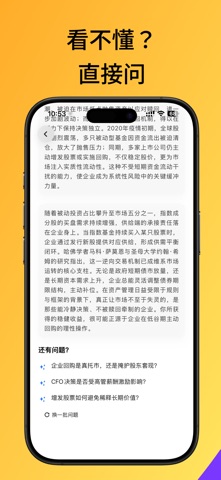
Shenme: an AI knowledge app built on a minimal card feed, where highlighting a sentence asks the follow-up
Shenme (the name means "What?") is an AI knowledge exploration app that presents content as a minimal card feed you swipe through topic by topic. It generates articles and illustrated explainers in real time from your behaviour, preferences, and every highlight and swipe, and it is built around a single interaction: highlight any sentence while reading and the explanation opens in place, without leaving the page.
Most knowledge products are structured as a catalogue, an article, and a search box, which assumes you already know what you are looking for. Shenme inverts that. Exploration is the entry point: the card feed spreads topics out, you stop on whatever catches you, and while reading you can push further on any sentence that is not clear yet.
The second design choice is not interrupting the reading. Select-to-ask puts the question entry point inside the body text, so the answer appears next to the passage rather than on a new screen that discards your context. This detail decides the cost of going deeper. If every follow-up means leaving the article, most people stop asking; if the follow-up happens beside the original sentence, chains of questions become realistic.
The third choice is that content is generated rather than selected from a fixed library. The vendor describes articles and visuals generated from user behaviour, preferences, and each highlight and swipe. Supply is therefore not limited by a fixed corpus, but accuracy depends on generation quality, so specific figures, conclusions, and quotations still need checking against a primary source.
What Shenme does
Minimal card feed
Content appears as stripped-back cards, and swiping left or right switches topic. The interface deliberately removes buttons and navigation so attention stays on the content.
Personalised generation
Articles and illustrated pieces are generated in real time from behaviour, preferences, and each highlight or swipe, so the same person may see different material at different times.
Select-to-ask
Highlighting text while reading opens an extended answer in place, with no interruption and no page jump. This is the feature the vendor treats as the differentiator, and it suits the moment you hit an unfamiliar concept mid-article.
Generated closing questions
Each article ends with three suggested follow-up questions. You can pick one, type your own, or request a fresh batch to keep digging into the same topic.
Favourites and sentence marks
Articles can be saved for later, and individual sentences can be marked separately, which makes it easier to pull out the useful lines and reuse them as writing material.
Sharing
Content can be shared with friends, either to start a conversation or to use a card as a prompt for writing or discussion.
Getting more out of it
- Swipe for a few minutes without a goal. Do not judge anything yet; just notice which topics hold you longer.
- Stop and read when a topic deserves it, and finish the piece before deciding to save it.
- When a term or an argument is unclear, highlight that sentence and check whether the in-place explanation actually answers your question instead of restating the text.
- Treat the three closing questions as a comprehension check: if you cannot answer them, the article has not landed yet and is worth another round of questions.
- Mark the specific sentences that are worth keeping rather than saving whole articles; marked lines are what you will actually retrieve later.
- For anything containing numbers, dates, named people, or research findings, verify against the original source before quoting. Generative text needs that backstop.
Pricing and availability
- The source page discloses no subscription price, free quota, or membership tier, and does not say whether any content is paid or usage-capped.
- No verifiable official product address is given, so download channels, supported platforms, and account requirements should be confirmed through official channels.
- This article does not speculate about pricing, in-app purchases, or free-tier policy.
Who it suits
- People without a specific search target who prefer following curiosity: a card feed fits that state better than an empty search box.
- Content creators who need wide cross-domain input, since cards and marked sentences convert directly into topics and raw material.
- Anyone using short gaps in the day to widen general knowledge; one card is sized for a few minutes.
- Product people interested in interaction design, because select-to-ask is a useful sample of an in-reading interaction pattern.
Limits worth knowing
- Content is model-generated and can contain factual errors, outdated information, or plausible claims with no traceable source. Verify anything that matters.
- Personalisation depends on continuous recording of behaviour and preferences, so privacy-sensitive users should decide for themselves whether that trade is acceptable.
- The claim of being a first-of-its-kind feature is a vendor statement, and the source provides no verifiable comparison.
- Pricing, platform coverage, and content moderation are not disclosed, and there is no statement about suitability for minors.
- A card feed suits breadth, not systematic depth. Learning a field properly still requires structured material.
Frequently asked
How does select-to-ask work in practice?
You select a passage while reading and the answer to that passage opens in place, without leaving the article or opening a new screen. Its value is keeping context so that follow-up questions can chain.
Is the content picked from a fixed library?
The vendor says articles and visuals are generated in real time from user behaviour, preferences, and each highlight and swipe, so supply is generative rather than a fixed corpus. The benefit is that volume is not capped by a library; the cost is that each item's reliability is on the reader to judge.
Can it be used offline, or exported?
The source says nothing about offline use or export. The retention options it names are favourites, sentence marks, and sharing.
Is it good for learning a field systematically?
Not really. The card feed is designed for breadth and interest-driven discovery, without a course-like sequence or complete coverage. It works as a way to find questions and widen perspective; systematic study still needs structured material.
Frequently asked questions
How does select-to-ask work in practice?
You select a passage while reading and the answer to that passage opens in place, without leaving the article or opening a new screen. Its value is keeping context so that follow-up questions can chain.
Is the content picked from a fixed library?
The vendor says articles and visuals are generated in real time from user behaviour, preferences, and each highlight and swipe, so supply is generative rather than a fixed corpus. The benefit is that volume is not capped by a library; the cost is that each item's reliability is on the reader to judge.
Can it be used offline, or exported?
The source says nothing about offline use or export. The retention options it names are favourites, sentence marks, and sharing.
Is it good for learning a field systematically?
Not really. The card feed is designed for breadth and interest-driven discovery, without a course-like sequence or complete coverage. It works as a way to find questions and widen perspective; systematic study still needs structured material.