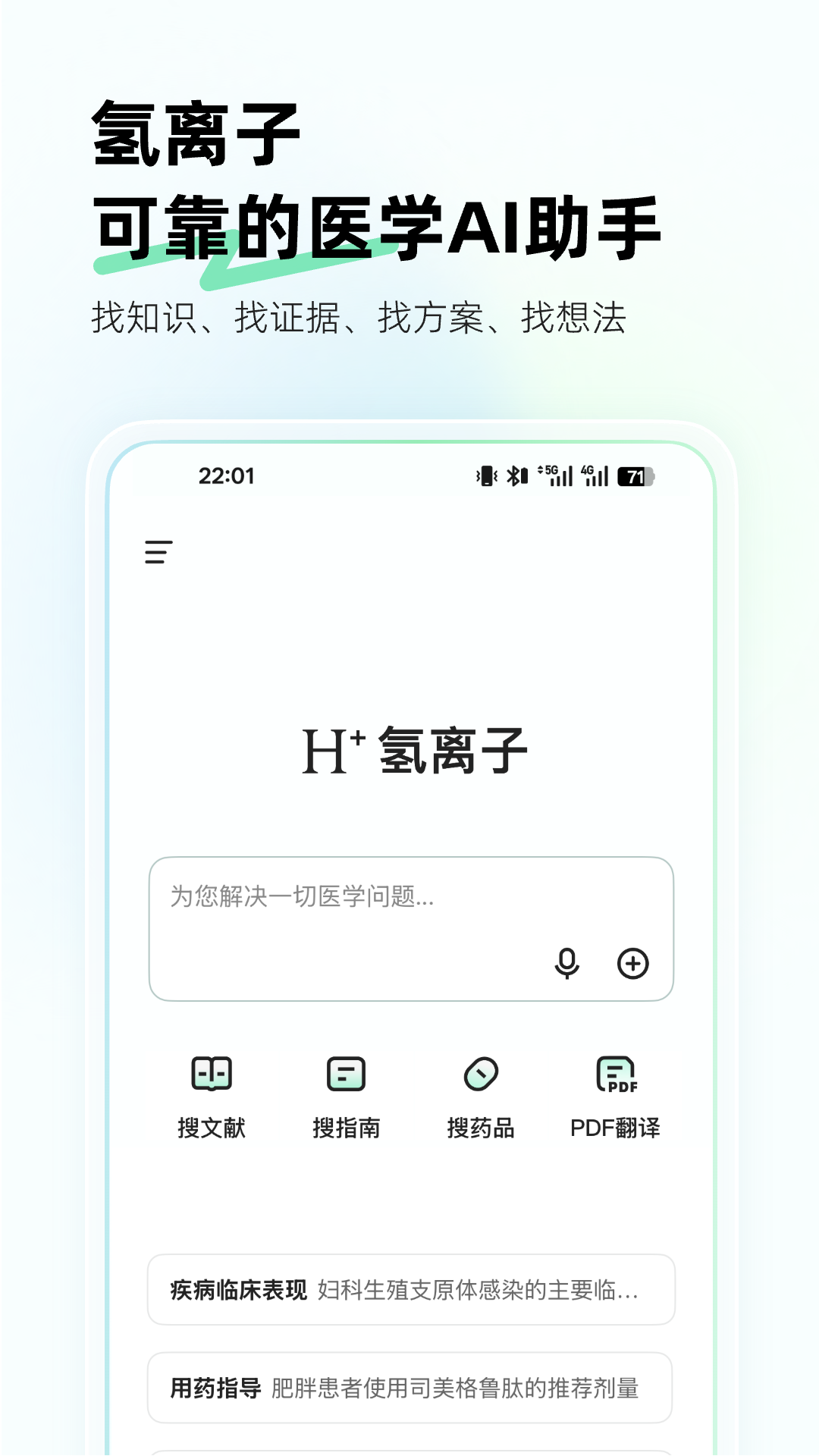
Qinglizi is a medical AI assistant from Alibaba Health built for healthcare professionals. It merges literature retrieval and reading into one flow: full-sentence natural-language queries with traceable claims, in-text highlighting of key passages, full-text translation shown against the original, and per-paper summaries with follow-up Q&A. Coverage is described as over ten million medical papers, more than ten thousand authoritative clinical guidelines, and a disease and drug knowledge base built with the People's Medical Publishing House covering over ten thousand conditions and more than sixty thousand drugs. The vendor states that its content is not a basis for diagnosis or treatment.
Qinglizi: Alibaba Health's Medical AI Assistant for Literature Search and Close Reading
Qinglizi is a medical AI assistant released by Alibaba Health and aimed at healthcare professionals. It places journal literature, clinical guidelines, and a disease and drug knowledge base behind a single search-and-read workflow, then applies natural-language querying, full-text translation with side-by-side originals, in-text highlighting, and summary Q&A to the three parts of medical work that consume the most time: finding the right paper, finishing it, and stating its conclusion accurately. The vendor states explicitly that its output is not a basis for diagnosis or treatment.
The problem in medical literature is not scarcity but volume. PubMed alone adds hundreds of thousands of records a year, and a single clinical question usually spans a dozen specialties and dozens of intervention types. Keyword search returns a list; the expensive part is judging which few papers deserve a full read, and then separating what a paper actually found from what its abstract claims.
Qinglizi connects the two halves. On the search side it accepts a full sentence instead of a keyword string, and the vendor states that returned viewpoints must be traceable back to source documents. On the reading side it highlights key passages in the original, translates whole papers while keeping the original visible for comparison, and generates a condensed summary with follow-up questions. For anyone reading across languages, the comparison view matters: medical wording changes meaning with a single qualifier, and a translation you cannot check against the source is hard to cite.
On coverage, the vendor claims more than ten million medical papers from Chinese and international sources, more than ten thousand authoritative clinical guidelines, and a knowledge base built with the People's Medical Publishing House covering over ten thousand diseases and more than sixty thousand drugs. Those three resources answer different questions: literature tells you what the latest research says, guidelines tell you what current practice recommends, and the disease and drug base tells you the baseline facts about a condition or a drug.
What Qinglizi does
Natural-language search
You type a complete question rather than a Boolean string. The system parses the intent and assembles the relevant literature, which suits questions phrased the way clinicians actually ask them, such as how a class of patients fares on a given treatment over the long term.
Traceable claims
Search results are designed so that a stated viewpoint can be traced to a specific document, including journal and year. In a clinical context this is the difference between a usable pointer and an unverifiable assertion.
Periodic tracking and systematic review
The vendor names two intended patterns: routine re-checking of the newest literature in one's own field, and a one-off sweep of the evidence across a defined area when writing a review.
Close reading with highlighting
Key passages in the original text can be highlighted so that methods, results, and conclusions stand out. This is for papers you have already decided to read but need to absorb quickly.
Full-text translation with source comparison
Whole papers can be translated while the original stays visible alongside. Because qualifiers, dosages, and inclusion criteria carry the meaning, reading both versions is what makes the translation usable.
Summaries and follow-up Q&A
Each paper gets a condensed summary of its main points, and you can keep asking questions about it. A practical order is to use the summary to decide whether the paper is worth a full read, then interrogate the methodology.
Guidelines plus disease and drug reference
More than ten thousand authoritative clinical guidelines, some free to read for a limited period, plus a disease and drug knowledge base covering over ten thousand conditions and more than sixty thousand drugs.
Interest-based recommendations and multilingual translation
Suggestions are drawn from your stated research interests and reading history, which helps surface material you would not have thought to search for. Multilingual translation covers reading across languages.
A workable sequence
- Write the question as one full sentence. Instead of stacking keywords such as a drug name, a comorbidity, and an outcome, phrase it as a question about what that drug does to that outcome in that patient group.
- Check whether each returned claim can be traced to a named journal and year. Anything that cannot be pinned to a document should not be carried forward.
- Run the summary first on each candidate paper to judge study design, sample size, and direction of effect before committing to a close read.
- Open the highlighting view for papers you keep, and read the methods and the actual numbers rather than only the conclusion sentence in the abstract, which usually drops the qualifying conditions.
- For non-native papers, read the translation with the original alongside and verify terminology, dosages, and population definitions against the source text.
- When mapping a whole field, collect results in batches and record your search dates and phrasing, so the sweep can be updated later rather than redone.
- For any decision about a real patient, confirm against the primary guideline and the approved product information. The assistant locates material; it does not substitute for either.
Pricing and access
- The source page discloses no subscription price, free quota, or paid tier, and does not distinguish an individual edition from an enterprise one.
- The only confirmed free detail is that some clinical guidelines are free to read for a limited period, which implies a permission layer over the guideline library and a time limit on that access.
- No verifiable official product site was available from the source, so activation paths and pricing should be confirmed through official channels. This article does not estimate figures.
Who it suits
- Clinicians who need to keep up with current evidence in their own specialty, or to locate guideline entries quickly when facing an unfamiliar comorbidity.
- Researchers and graduate students building a literature review, hunting for gaps, or grading the strength of existing evidence.
- Medical students and residents who want to connect textbook conclusions to the primary papers behind them.
- Medical affairs and market access teams in pharmaceutical and device companies tracking guideline updates across languages.
Limits to know first
- It is not a basis for diagnosis or treatment. The vendor says so directly, and that boundary is what keeps the tool in an advisory role.
- The coverage numbers, including the claim of broader reach than PubMed, are vendor statements without a published method for independent verification.
- Limited-period free access to guidelines means access can change; a long project that depends on the guideline library should plan for that.
- Pricing, regional availability, and update frequency are not disclosed, and it is unclear whether the tool indexes the specific journals your institution subscribes to.
- Summaries compress. Before citing anything, verify methodology and figures in the original, especially dosages, contraindications, and population constraints.
- As a professional tool it assumes domain literacy; readers without medical training can easily misjudge how far a conclusion generalises.
Frequently asked
How is this different from a literature database?
A database gets you to the paper. Qinglizi adds the reading layer: sentence-level queries, in-text highlighting, translation against the original, per-paper summaries, and follow-up questions. It does not replace an authoritative index; it reduces the cost of what happens after retrieval.
Can results be cited directly?
Not the second-hand summary. A claim has to be traced to the paper, and citations should follow the original's journal, year, design, and figures. Traceability is a design goal, but the verification step still belongs to the reader.
Which languages can papers be translated from?
The vendor describes full-text translation with side-by-side originals and multilingual translation, but does not publish a complete language list. Check what the product actually offers.
Is there a free tier?
The source mentions only limited-period free access to some guidelines. Whether search, translation, and summarisation are free or metered is not stated; assume cost should be confirmed officially.
How reliable are the answers?
Reliability rests on two things: whether the claim traces to a document, and whether you check that document. Treating it as a retrieval and pre-reading aid is sound; treating it as clinical judgement is outside its stated scope.
Frequently asked questions
How is this different from a literature database?
A database gets you to the paper. Qinglizi adds the reading layer: sentence-level queries, in-text highlighting, translation against the original, per-paper summaries, and follow-up questions. It does not replace an authoritative index; it reduces the cost of what happens after retrieval.
Can results be cited directly?
Not the second-hand summary. A claim has to be traced to the paper, and citations should follow the original's journal, year, design, and figures. Traceability is a design goal, but the verification step still belongs to the reader.
Which languages can papers be translated from?
The vendor describes full-text translation with side-by-side originals and multilingual translation, but does not publish a complete language list. Check what the product actually offers.
Is there a free tier?
The source mentions only limited-period free access to some guidelines. Whether search, translation, and summarisation are free or metered is not stated; assume cost should be confirmed officially.