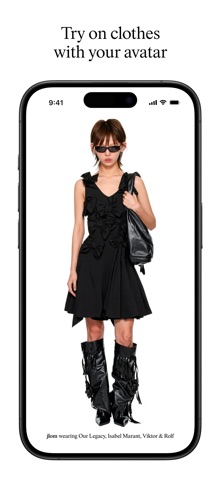
Doji is an AI fashion try-on app: shoot or upload a photo, preview designer clothing on yourself, and get styling suggestions before deciding to buy.
Doji: an AI virtual try-on app that shows the outfit on you first
The least predictable part of buying clothes is the cut. The same jacket can look like two different garments on two different body shapes, and fitting rooms come with their own constraints: store hours, stock, travel time. Doji moves that step onto your phone screen. It is an AI fashion try-on app that lets you see how a piece looks on you before you buy it or stand in front of a mirror.
The core of Doji is virtual try-on. You can shoot with the phone camera or upload a photo you already have, and the app composites the selected garment onto your own image, showing the result on screen. Compared with flipping through a model's shots, a preview built around your own body is a far closer reference, especially when you are judging whether a style fits the way you actually dress.
The breadth of the wardrobe is the other thing it emphasises. Doji covers a wide range of designer brands, so you can switch between labels and mix pieces across them instead of being locked inside one catalogue. That side-by-side comparison is exactly what physical shopping struggles with: a store only carries its own stock, while one screen can hold many.
What happens after the try-on is accounted for too. A look you like can be shared to social media to get a second opinion, and if it holds up you can follow an in-app link straight into a purchase. Browse, ask, buy sits on a single path instead of being scattered across several apps.
Main features
Virtual try-on
Shoot with the phone camera or upload a photo, and the app uses AI to composite the chosen garment onto your figure so you can see how it sits in real time.
Brand and style range
Many well-known designer labels are covered, and you can switch between brands and styles freely to build combinations.
Personalised recommendations
Suggestions take your body shape, style preferences and previous try-on history into account rather than offering a generic feed.
Styling advice
Guidance on pairing tops with bottoms and building layers helps you turn a single piece into a complete look.
Social sharing
Send a try-on result to social platforms, collect reactions from friends and add an outside opinion to the decision.
Shopping links
When a piece interests you, an in-app link takes you into the purchase flow so you do not have to hunt for the same item elsewhere.
How to use it
- Prepare a photo. Open Doji, allow camera access and shoot directly, or upload a front-facing photo with even lighting and little occlusion. The closer the photo is to a normal snapshot, the easier the result is to judge.
- Pick garments. Browse by brand or by style and select the pieces you want to try; you can also queue several first and compare them afterwards.
- Generate the try-on. Confirm and wait for the composite, then look at how the garment reads on your own figure.
- Swap and repeat. Try the same trousers with a different top, or the same jacket over a different bottom, until the combination feels right.
- Read the recommendations. Check whether the suggested directions match the situations you actually dress for.
- Share or buy. Send the result you like to friends, and when you are ready, follow the shopping link to the order page.
Who it suits
- People tired of online returns: see the fit before ordering instead of discovering that a well-photographed piece does not work on you.
- Designer-brand shoppers without local stockists: reach labels that have no store within reasonable distance.
- Creators and styling accounts: generate visual material for several looks quickly, for concept testing or content planning.
- Anyone reorganising a wardrobe: check whether a new piece works with what you already own before buying another version of the same thing.
- Learners of styling: run many low-cost experiments to understand how colour, proportion and cut interact.
Limits and things to keep in mind
- Results depend on photo quality. Low light, odd angles or an occluded body make the composite unreliable, so a straight-on, evenly lit photo is worth the effort.
- It cannot replace physical information. A screen does not convey how a fabric drapes, how heavy it feels or how it handles in the hand, and true sizing still comes from the retailer's measurements.
- The catalogue is whatever the app offers. Available brands and styles are set by the product and can change over time; this article makes no promise about a specific roster.
- Recommendations need data. Personalised suggestions lean on the preferences you enter and the try-ons you accumulate, so early use gives thinner guidance.
- Purchases are handled by third parties. Price, stock, delivery and return terms follow the page you are sent to; a preview inside the app is not a purchase commitment.
FAQ
Is Doji free?
The available material contains no confirmed pricing information, so this article does not speculate about cost. Check the in-app description for whether it is free and whether any limits apply.
Do I need special equipment?
No. A phone camera or an existing photo is enough input, which is the whole point of a consumer-facing try-on app.
Can I buy clothes inside Doji?
The app provides shopping links that lead into a purchase flow. The merchant, price and after-sales terms are those of the destination page.
Can a try-on stand in for sizing?
Only as a reference for style and silhouette. Fit depends on actual measurements and fabric stretch, so pair it with the retailer's size chart.
Frequently asked questions
Is Doji free?
The available material contains no confirmed pricing information, so this article does not speculate about cost. Check the in-app description for whether it is free and whether any limits apply.
Do I need special equipment?
No. A phone camera or an existing photo is enough input, which is the whole point of a consumer-facing try-on app.
Can I buy clothes inside Doji?
The app provides shopping links that lead into a purchase flow. The merchant, price and after-sales terms are those of the destination page.
Can a try-on stand in for sizing?
Only as a reference for style and silhouette. Fit depends on actual measurements and fabric stretch, so pair it with the retailer's size chart.